
“The Legend of Tennessee Moltisanti” Review
Grade: A-
“Cat on a Soft Tar Roof”
Christopher Moltisanti has always been a favorite among Sopranos fans. Although his loose-cannon antics lead to trouble, the overwhelming tragedy of his storyline is among the most complex arcs on the entire show. And it all starts with “The Legend of Tennessee Moltisanti.”
Played by Michael Imperioli, Christopher was introduced throughout the first couple episodes as a cocky hotheaded douchebag. He was finally humbled in “Denial, Anger, Acceptance” after receiving a mock execution, which was enough to gain a little sympathy. However, “The Legend of Tennessee Moltisanti” is the first time where the character truly earns our empathy.
The episode begins in Chris’ dreams, which is a strange feel at first but quickly turns out to be the best dream sequence so far, full of surreal visuals and cryptic motifs and Luis Buñuel-style edits. Every night, Chris is being haunted by the ghost of Emil Kolar, the man he killed back in the pilot, and it’s enough to drive him paranoid.
Meanwhile, during his waking hours, Chris attempts to write a movie script. The key word is “attempts” — after all, he thought the computer would do most of the work. His low self-esteem is further deflated when the now-deceased Brendan Filone is referred to as a Soprano family “associate” on a local news report. Even with Adriana there to cheer him up, Chris falls into a depressive funk.

Tony and Carmela watch the same news report, preparing for the worst. An interesting character shade to Carmela in this episode: the entire series, she effectively remains in denial about her complicit role in Tony’s life of crime, yet here she is, helping him stow away cash, guns and stolen jewelry in preparation for federal indictments.
In true Sopranos fashion, the threat of the FBI isn’t all that successful. Agent Harris and the feds arrive with a warrant, search the house, find nothing, another agent named Grasso breaks a bowl and that’s that. The storyline takes a backseat to what series creator David Chase truly wants to examine — the role of Italian-Americans being cast in a bad light because of the Mafia.
This is thematic territory that Chase will return to time and time again, but it unfortunately results in some of the series’ most expository dialogue. After the raid, Tony and Carmela preach to their kids that law enforcement has always treated Italians unfairly. “It’s like Michelangelo never existed!” At dinner, they show pride for the old country by referencing famous Italians throughout history. “Everybody knows Antonio Meucci invented the telephone!” And Tony dispels any notions of the Chinese having invented pasta. “Why would people who eat with sticks invent something you need a fork to eat?”

The viewpoints of the Soprano family are then contrasted with the viewpoints of the Melfis. This is our first look at Dr. Melfi’s extended family, but the look into their personal lives feels a bit unnecessary and ultimately too disconnected. Her son, Jason, is a pretentious smart-aleck, and her ex-husband, Richard, an arrogant prick, but even Melfi herself is a touch too didactic in these scenes. Her disdainful demeanor feels unnatural, and actress Lorraine Bracco’s delivery feels labored and forced.
Ultimately, Richard is ashamed of his Italian heritage, and when he finds out that Jennifer is treating a mobster, he becomes frightened. He suggests Melfi stop seeing her special patient. “Soon you’re going to get down to good and evil. And he’s evil.” It leaves her in the curious personal and professional position of having to defend Tony Soprano’s character.
When The Sopranos shines a light on Melfi’s personal life, it usually feels like a completely different show. And when The Sopranos runs a social commentary on Italian-American culture, it results in some of the series’ most on-the-nose moments. The two elements are combined here, making for one of the show’s more forgettable subplots. Yet there still remains a certain novelty for it being the first occurence.

“The Legend of Tennessee Moltisanti” earns its high marks mainly for the Chris storyline, in which he goes from hubristic punk to lovable underdog. Full of pathos and humor, his Hollywood aspirations also carry a shade of tragedy. Although Chris dreams of writing mob stories, he’s forever confined to be a secondary character stuck in one, literally and metaphorically.
Take this scene, for example — Chris is waiting in line at the bakery, feeling downtrodden. To make matters worse, the cashier behind the register is being a major asshole for no good reason. Fed up, Chris pulls out his gun, forces the kid to fill a box with cannoli and then shoots him in the foot. “It happens.”
It’s a hilarious scene that shows gruesomely endearing shades to Christopher’s character. On a more serious note is his conversation with Paulie, in which he confesses that he’s been depressed, unable to find purpose in life. The apartment is dark and dingy, with perfect music in the background. Backed by “Summertime” by Booker T. & the M.G.s, the scene carries great emotional weight. “Where’s my arc, Paulie?”
In a similar vein is his conversation with Tony. After Tony boxes Chris in the head and chastises him for his carelessness throughout the episode, he feels sympathy for his nephew and tries to connect with him. However, the conversation goes nowhere. Chris remains too closed off and distant, unable to confess his true feelings. Same for Tony, who is unable to admit he’s seeing a therapist.
The scene is excellent in the way that it shapes the whole Tony and Chris dynamic throughout the series. Although they try to view each other as surrogate father and son, there is very little connection between them.

Haunted by nightmares, a failed script and a lack of recognition, Chris spends the days lying in bed. But a phone call from his mother voicing concern over his name being mentioned in the newspaper is enough to give him a renewed sense of purpose.
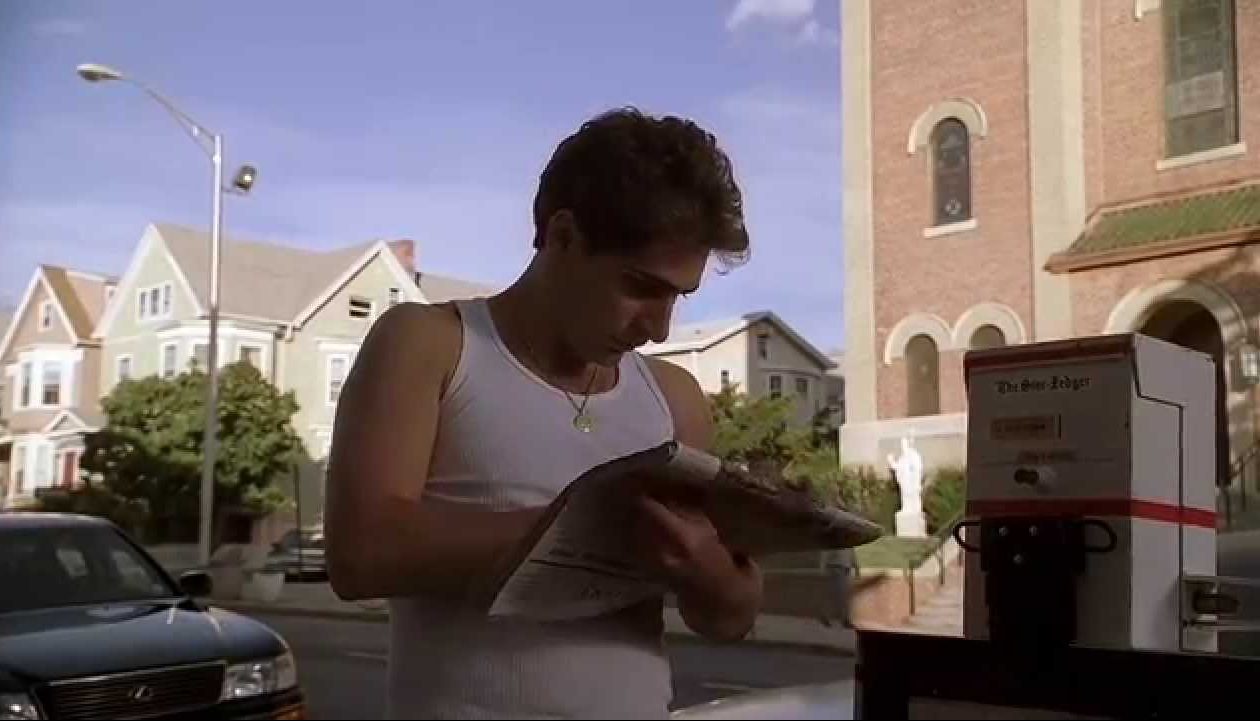
The episode ends with a shot of Chris driving to the nearest street corner and joyfully seeing his name in print. With a smile on his face, he grabs the entire stack of Star-Ledger’s and then speeds off. A great moment for our newest antihero.
Once a television character has had a moment that truly endears them to you, it’s hard to turn your back on them. Despite “The Legend of Tennessee Moltisanti” featuring some dry social commentary in the Melfi subplot, the episode is best remembered as a signature triumph for Chris. A character-defining installment.
STRAY ROUNDS
- Early in the episode, Tony explains to Dr. Melfi that he might need to miss a session or two because of the impending indictments. After he fails to show up for one of his weekly sessions, Melfi still charges him for the missed time. This greatly upsets Tony, and I tend to agree with him. He storms out of their next meeting, but not before throwing the money at her face, comparing her to a call-girl.
- “The Legend of Tennessee Moltisanti” features a couple scenes that drag on for too long, most notably the ones involving Melfi’s family. A group therapy scene toward the end of the episode, in which the Melfi’s meet with a family psychiatrist, attempts dry humor but completely misses the mark. The entire sequence is awkward and out of place.
- Also in the episode, Uncle Junior meets with Livia at the nursing home to have a conversation about Tony. She tells him that Tony is seeing a psychiatrist, but the entire scene is undercut by the terrible stand-up comedian in the background. It’s cringeworthy, turning a crucial reveal into a throwaway scene that brings down the entire episode.
- I don’t know which members of the writer’s room were specifically responsible for these occasional deadpan, awkward-on-purpose, cringe comedy aspects of The Sopranos, but thankfully they’ll be completely gone by early season 2.
- Chris shooting the bakery boy in the foot is an homage to a scene in Goodfellas, in which Michael Imperioli played Spider, who was shot in the foot by Joe Pesci’s character. Joe Pesci, as Tommy Devito, gives Spider the same excuse: “It happens.”
- Season one continuity error: Gino, a customer waiting in line at the bakery, played by Joseph R. Gannascoli, will later be recast as Vito Spatafore, who will first appear in season 2 and gain an unlikely prominent role by seasons 5 and 6. No mention of Gino will ever be made again. Timeline got fucked up.
- “The Legend of Tennessee Moltisanti” was written by Frank Renzulli and series creator David Chase and directed by Tim Van Patten. This is the first episode helmed by Van Patten, and he’ll ultimately become the series’ most prolific director (20 episodes total). He does great work here, most notably in the opening dream sequence.
FAMOUS LAST WORDS
- “Oh, so I could go out, fuck your sister, come back Saturday and I could go to the front of the line?”
- “You know who had an arc? Noah.”
- “It’s just that the fucking regularness of life is too hard for me or something. I don’t know.”
Discover more from Colin's Review
Subscribe to get the latest posts sent to your email.
2 thoughts on “The Sopranos Season 1 Episode 8: “The Legend of Tennessee Moltisanti””