
Yankee Doodle Dandy
Grade: A
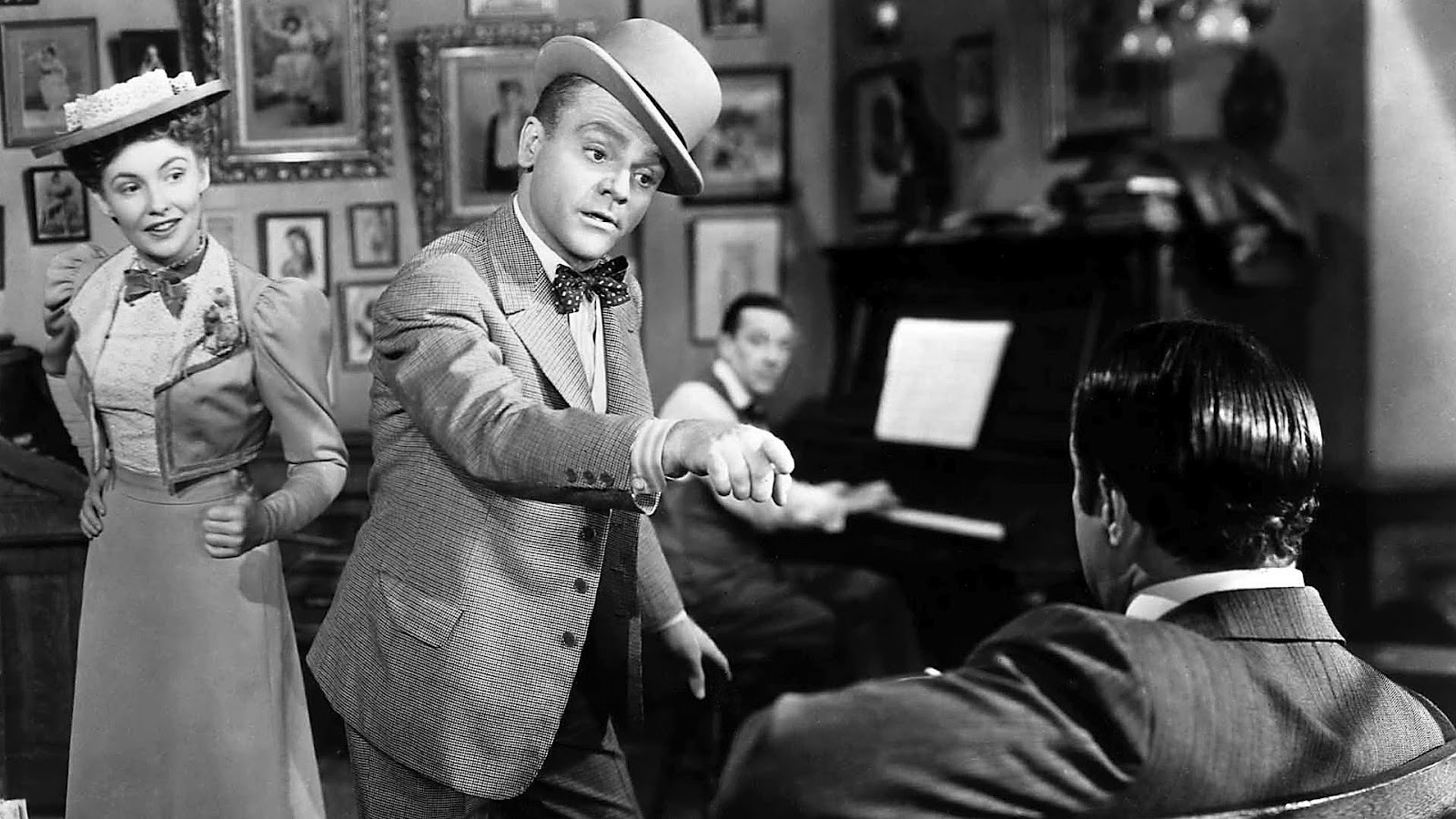
In discussions of “best music biopic,” I usually conclude that Yankee Doodle Dandy — a 1942 film about turn-of-the-century revue man George M. Cohan — is the greatest of them all. Not all biopics are about sex, drugs and rock ‘n’ roll; some happen to be about family, patriotism and vaudeville. And because Cohan is largely forgotten today (and probably already somewhat forgotten by 1942), Yankee Doodle Dandy also provides an important history lesson about the pre-World War I days of American popular music. It’s a great film — propaganda you can be proud of.
Directing:
Has any other director had a better year than Michael Curtiz in 1942? Perhaps Francis Ford Coppola in 1974 deserves mention, but Yankee Doodle Dandy and Casablanca (and Captains of the Clouds) is hard to top. As those films display, Curtiz was one of the most versatile directors in Hollywood history; a natural workman with a distinct visual style relying on fluid camera movement and high-contrast lighting. His full arsenal is on display in Yankee Doodle Dandy, and the storyline flies through the 1870s to the 1940s without missing a beat. The only other film I can think of that integrates time jumps so seamlessly is Citizen Kane, released the previous year.
Acting:
A far cry from his usual gangster roles, James Cagney’s performance as George M. Cohan is perhaps the iconic actor’s best. Who knew he could sing and dance with such charisma? Even though he talks his way through most of the lyrics and stiff legs his way through most of the tap routines, Cagney’s crazed energy is infectious. The opportunity to display his natural showmanship is a welcome departure from his previous roles as hard-edged criminal. He’s by far the film’s most important and engrossing element, and his Academy Award is well deserved.
Writing:
Yankee Doodle Dandy isn’t entirely accurate — the film version of Mary Cohan is a composite of Cohan’s ex and second wife, and the timeline is adjusted in certain spots for dramatic purposes. Other than that, however, the Cohan story is invigorating and easy to follow. Framed from the perspective of an aged Cohan narrating his autobiography to President Franklin D. Roosevelt in the Oval Office, we flashback through every major event in his life, from early childhood to elderly retirement. There are extravagant musical numbers and emotional family tragedies; comedy in one scene, poignant drama in the next. Through it all, Cohan’s story becomes the story of America itself. He pulls himself up by his bootstraps, becomes the biggest sensation on Broadway and remains staunchly devoted to his country and fellow countrymen.
Yankee Doodle Dandy is nationalism done right — a reminder of all the great things that America stands for, without any of the political preachiness such sentiment usually entails.
Music:
Cohan’s songs have stood the test of time for their novelty and their patriotism and, ultimately, their catchiness — raise your hand if you’ve ever absentmindedly hummed “You’re a Grand Old Flag” in public. The musical sequences and corresponding set-pieces throughout Yankee Doodle Dandy are fantastic, with “The Yankee Doodle Boy” in particular being the movie’s most memorable number. It proves that Cohan was the perfect subject for a musical biopic: an ambitious composer with unbridled determination and the tunes to back up all his boasts.
Ending (SPOILERS):
In the beginning of the film, the FDR framing device seems to be a convenient way to make the storytelling easier (while also drumming up real-world support for World War II). By the end of the film, however, Yankee Doodle Dandy comes full circle, awarding Cohan with the Congressional Gold Medal for a lifetime of service to the U.S.A. It’s well deserved and well executed: Cagney’s humble acceptance is perfectly befitting of the character he’s played so faithfully, and his final tap dance down the long staircase is as rousing as “The Star Spangled Banner” itself.
All in all, Yankee Doodle Dandy’s ending successfully wraps up both of its simultaneous storylines, Cohan’s past and Cohan’s present, with a jubilant reprise of “Over There,” a great conclusion to one of the most feel-good movies of all time.
“My mother thanks you, my father thanks you, my sister thanks you, and I thank you.” — George M. Cohan
Why Yankee Doodle Dandy gets an A
The greatest music biopic ever made certainly deserves to be called a Grade-A classic, and Yankee Doodle Dandy is exactly that: an all-American success story with fantastic musical numbers and a powerhouse performance from James Cagney. Maybe the best movie ever made by director Michael Curtiz.
Accolades:
Colin’s Review Best Films of the 1940s
Discover more from Colin's Review
Subscribe to get the latest posts sent to your email.
One thought on ““Yankee Doodle Dandy” (1942)”