
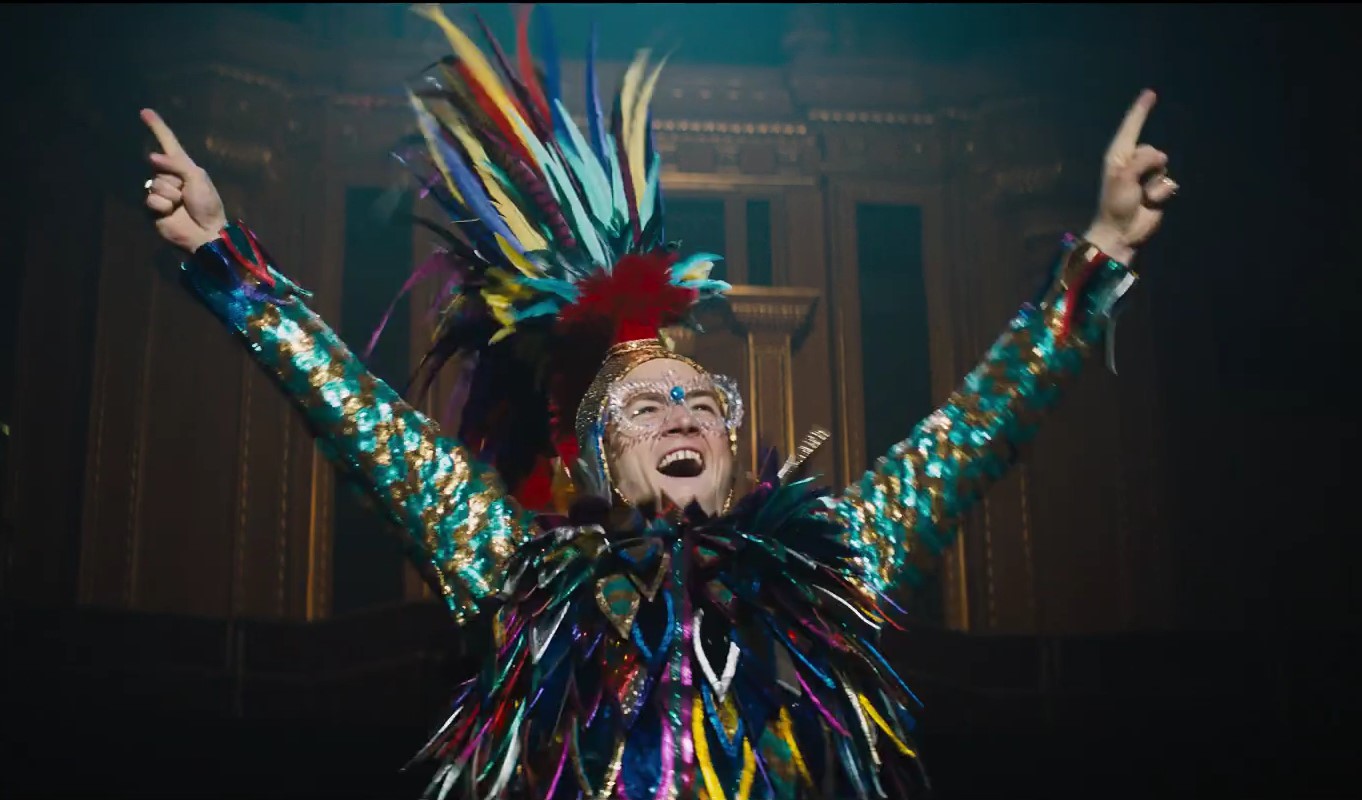
Rocketman
Grade: B
Dexter Fletcher directed Bohemian Rhapsody in 2018, and the huge success of that film led him to create Rocketman, his Elton John-focused follow-up. On all fronts, Rocketman is a superior movie: the music is better, the acting is stronger and Sir Elton’s story is simply much more compelling than Freddie Mercury’s. Even though I’m not the biggest Elton fan in the world (I own Goodbye Yellow Brick Road on CD, Elton’s best album, which I would tentatively grade as an A-minus), I enjoyed watching his life story for the most part. A few more notes on Rocketman:
Directing:
Fletcher can’t help being cheesy: even though Elton based his entire persona on glam extravagance, the music video scenes (e.g., the humanoid missile of “Rocket Man”) go beyond “campy” and instead come across as “corny.” For the most part, however, Rocketman is a finer crafted film than Bohemian Rhapsody, with editing that is more fluid and a storyline that is more faithful. Nevertheless, I didn’t find the framing device (Elton recounting his life story in a therapy session that may or may not be real) all that necessary, but I suppose that’s just Fletcher being cheesy once again. Or he’s just playing it safe and taking an easier approach toward storytelling.
Acting:
Taron Egerton, of Kingsman fame, delivers a career-best performance as the artist formerly known as Reginald Dwight. He’s a great big flamboyant ball of energy (a humanoid missile, if you will), and he fully inhabits what the role requires of him. Perhaps the part comes so naturally because, as the film poignantly observes, Elton himself was playing a role his entire career. But singing like Elton takes real skill and talent, and Egerton’s renditions of the artist’s biggest hits are superb. He’s the most “soundalike” biopic portrayal since Joaquin Phoenix in Walk the Line. Even if you’re not a fan of Elton, watch this movie and become a fan of Egerton.
Writing:
Scenes I liked: the early sequences depicting Dwight’s childhood/Elton’s origin; the realistic portrayals of how he and lyricist Bernie Taupin crafted their songs; the way the musical numbers didn’t impede upon the more dramatic elements.
Scenes I didn’t care for: the party sequences that leaned too hard into sex, drugs and rock ‘n’ roll bacchanalia; the aforementioned corny “Rocketman” music video fantasy; the premise of the therapy session framing device.
Overall, an entertaining biopic with a somewhat muddy timeline, but because John’s career doesn’t culminate in any sort of climax, the film is more homage than actual story.
Music:
Even if you don’t like Elton’s music, you simply can’t deny how supremely catchy his songs remain. I wish the film had included “Levon,” but that’s to be expected I suppose. The draw of Rocketman is that it’s not just the same old songs…it’s Egerton singing the same old songs, which adds credibility to the world of the movie.
Ending (SPOILERS):
As mentioned before, the ending sort of fades into the background because, well, the story of Elton John never really ended: up until 2023, he was still performing concerts and dominating the charts. His most interesting era from a storyline perspective is circa 1970, which ultimately makes Rocketman fizzle out by the time we reach the 1980s. I can’t fault Elton’s life for not honoring a three-act structure, but it does limit things from a biopic standpoint.
“People don’t pay to see Reginald Dwight! They pay to see ELTON JOHN!!” — Elton John
Why Rocketman gets a B:
Due to its surface-level storyline, Rocketman won’t create new Elton John fans, and it likely won’t completely satisfy the die-hards either. Overall, the film plays things too safe, with cinematic flourishes that make things feel “fake” in a Hollywood sort of way. However, Taron Egerton’s fantastic lead performance makes the film worth seeing.
Discover more from Colin's Review
Subscribe to get the latest posts sent to your email.