
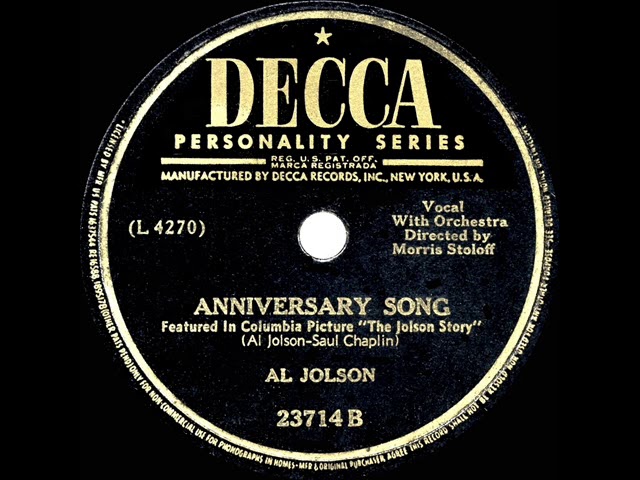
30. “Anniversary Song” by Al Jolson
Once upon a time, Al Jolson was the 1910s Artist of the Decade and placed #32 in the 1920s Best Songs with “Swanee.” What a pleasant surprise, then, that Jolson would resurface in 1947 with “Anniversary Song,” a powerful tune that confirms what so many music fans had by that point forgotten: that Jolson is and always was one of the greatest singers in American popular music history.
A fitting homage to days gone by, “Anniversary Song” is an adaptation of an old Romanian waltz from the time of Jolson’s birth in 1886, repurposed with new lyrics and a deeper timbre. The song contains all the dramatics of Jolson’s vaudeville heyday but with a restrained wisdom earned with age.
29. “I’ll Never Smile Again” by Tommy Dorsey & Frank Sinatra
The first chart-topper in Billboard history, “I’ll Never Smile Again” is one of the most beautiful songs of the decade. Frank Sinatra, just 25-years-old at the time, delivers a delicate and tender vocal performance that perfectly matches Tommy Dorsey’s subdued, celesta-tinged arrangement. Romantic tunes like this can easily slip into mawkish sentimentalism, but “I’ll Never Smile Again” stands apart due to its quiet restraint.
28. “The Honeydripper” by Joe Liggins
Led by a bass-heavy boogie-woogie beat and a pair of exuberant saxophones that drive the melody, Joe Liggins’ “The Honeydripper” is perhaps the definitive rhythm & blues song. It’s joyous, danceable and boisterous; a tune that instantly brings good vibes. In live performances, Liggins would let the good times roll for 15 minutes, and what I wouldn’t give to hear a hootenanny like that. Probably the most fun song since The Boswell Sisters’ “Everybody Loves My Baby.”
27. “How High the Moon” by Ella Fitzgerald
Jazz legends like Louis Armstrong and the Boswell Sisters helped popularize scat singing, but Ella Fitzgerald was the one who perfected it. Her fast-tempo adaptation of “How High the Moon” is a high point of the art form, featuring a blistering solo of nonstop bee-bah-boo’s that remains a technical marvel. It proves two things: 1) you can be a jazz virtuoso without even “playing” an instrument; and 2) Fitzgerald is the most talented singer of all time.
26. “Move” by Miles Davis
Although Miles Davis made his bones playing bebop with the likes of Charlie Parker and Dizzy Gillespie, he was already looking past the genre and aiming to expand jazz’s musical language. In 1949, his nine-piece band integrated impressionist classical techniques into bebop’s complex parameters to invent “cool jazz.” “Move,” the first piece on the eventual Birth of the Cool compilation, is a stellar introduction to the new sound.
The song is a brilliant study in contrasts: a big band arrangement featuring small-group dynamics; complex unison harmonies that burst into powerful yet understated solos; a variety of tonal moods that change emotion from bar to bar. There are so many ideas in “Move,” so many key changes taking the song in unexpected directions, that it can be played endlessly and still reveal something different each time.

25. “Pretty Boy Floyd” by Woody Guthrie
Has there ever been a troubadour as great as Woody Guthrie? He’s the definitive American folk singer: without him, the modern-day singer/songwriter simply does not exist. And his greatest contribution to the genre, at least according to Colin’s Review, is “Pretty Boy Floyd,” the entertaining tale of an Oklahoman outlaw who became idolized for his Robin Hood antics. The song features some of Guthrie’s strongest melodies and funniest lyrics, a winning combination that made him — and the actual Pretty Boy Floyd, for that matter — a working-class hero for all generations that followed. Fantastic senior quote idea: “Through this world I’ve wandered, I’ve seen lots of funny men/Some will rob you with a six gun, and some with a fountain pen.”
24. “Mule Skinner Blues” by Bill Monroe
Bluegrass is, essentially, jazz for hillbillies. That’s not meant as an insult — just listen to “Mule Skinner Blues” by the genre’s founding father, Bill Monroe, to get a sense of how liberating the style can be. Originally written and recorded in the early 1930s by country legend Jimmie Rodgers, Monroe’s 1940 adaptation reimagines the song as a fast-paced stomp with soaring fiddles, rapid acoustic strumming and high ‘n’ lonesome hollering vocals echoing out across the Appalachians. Very few tunes in human history compel the listener to yodel at the top of their lungs; “Mule Skinner Blues” is one of them.
23. “Move It on Over” by Hank Williams
A humorous song about an adulterous man sleeping in a literal doghouse shouldn’t be this profound. Then again, Hank Williams had such a gift for expressing the trials and tribulations of everyday life that you can’t help but be affected by “Move It on Over.” The lyrics are hilarious yet filled with ancient truths (“This doghouse here is mighty small, but it’s better than no house at all”), all sung in Williams’ uniquely expressive, rough-around-the-edges, relatable twang. And the arrangement — a rollicking honky-tonk featuring some excellent electric guitar solos — might have invented rockabilly a decade before its time. It all goes to show that Williams possessed the type of natural, off-the-cuff genius that only comes around once in a generation.
22. “All the Things You Are” by Dizzy Gillespie
The genius of Dizzy Gillespie’s 1945 recording of “All the Things You Are” is how effortlessly the song slides from one dreamy solo to the next. Beginning with a slightly ominous introduction, Gillespie’s soft trumpet quickly eases the tension. A relaxing alto sax from Charlie Parker follows, which leads to Slam Stewart’s bowed double bass showcase — the magic center of the song. After this ghostly interlude, pianist Clyde Hart starts a beautiful solo and hands it off to electric guitarist Remo Palmieri who finishes it. Gillespie’s fluttering trumpet returns for the concluding touches, and a reprise of the ominous intro leaves us with an epilogue filled with unresolved ambiguity (with Gillespie quoting one-half of “A Night in Tunisia” as a teaser).
“All the Things You Are” is over too soon, but the amount of musical genius contained in its short three-minute runtime has been enough to keep listeners occupied for the past 80 years. It’s Gillespie’s greatest song.
21. “Strange Things Happening Every Day” by Sister Rosetta Tharpe
Truer words have never been spoken: there are strange things happening every day. Except Sister Rosetta Tharpe doesn’t just speak these words; she sings them from the very depths of her soul. If Jesus Christ our Savior doesn’t make you a believer, then Tharpe certainly will. Her conviction — coupled with her virtuoso guitar abilities — is enough to convert you to the Gospel. Or, at the very least, gospel music. Another miracle: Tharpe’s soulful style sounds remarkably like rock ‘n’ roll despite “Strange Things Happening Every Day” being released in 1944.
Jump to a Section