
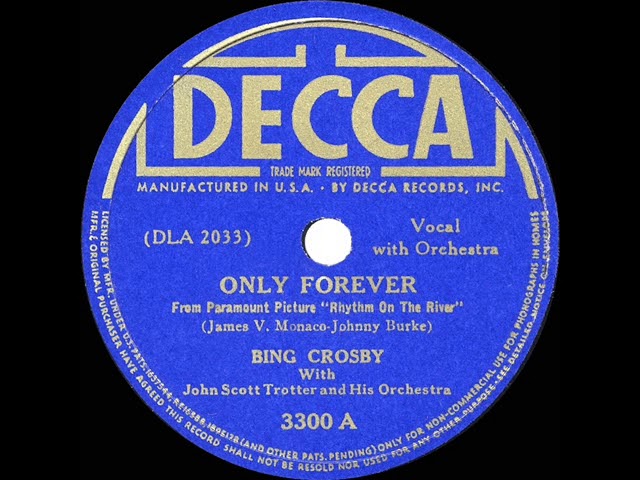
10. “Only Forever” by Bing Crosby
Bing Crosby’s 1940 hit “Only Forever” contains two of the sweetest couplets ever written in the English language. Back to back, no less:
- “How long would it take me to be near if you beckoned? Offhand I would figure, less than a second.”
- “Do you think I’ll remember how you look when you smile? Only forever, that’s putting it mild.”
Of course, merely reading the words doesn’t do them justice. The real poetry is in the way Crosby croons these lines, unwavering in his sincerity. Accompanied by a plaintive string arrangement by John Scott Trotter, “Only Forever” is — and maybe I’m caught up in the moment and generalizing, but only slightly if I am — the greatest love song ever.
9. “Ruby My Dear” by Thelonious Monk
Thelonious Monk is noted for his dissonant style and occasional harsh use of atonality. But one element of his music that always gets underrated is just how beautifully melodic it can be. Recorded in 1947 and compiled on the Genius of Modern Music sessions, “Ruby My Dear” is Monk at his most romantic. He uses dissonance to his advantage in this tender ballad, with angular piano runs that cathartically return to more conventional harmonies at just the right times. Rarely does Monk resolve his melodies, but “Ruby My Dear” is the rare Monk standard where tension isn’t the main musical focus.
8. “Hold Me” by Peggy Lee
The closing track on Peggy Lee’s 1948 debut LP, Rendezvous With Peggy Lee, “Hold Me” builds to a surprisingly epic climax, showcasing an instrumental ambition that set her apart from her vocal jazz contemporaries. As Lee’s voice hovers above a free-flowing whirlwind of flute-and-brass crescendos, the song (and album) concludes with an artfully ambiguous bang — a mesmerizing apogee that reminds me of The Beach Boys’ “In the Back of My Mind.”
7. “Out of Nowhere” by Charlie Parker
Charlie Parker’s most beautiful ballad, “Out of Nowhere,” is slow and spare. Despite the tempo, he delivers a fiery solo that rains down cascading sheets of sound. It’s a complete display of Parker’s preternatural talent: an unmatched technical virtuoso conveying an extraordinary depth of emotion. And he only needs two minutes to make his point (Bird hands off the final half of the track to Miles Davis). More than any other song in his catalogue, “Out of Nowhere” showcases Parker’s dynamic sense of lyricism and his incalculable influence on modern jazz.
6. “Boogie Chillen’” by John Lee Hooker
Raw, minimal, droning, free-form, trance-inducing — John Lee Hooker’s 1948 recording of “Boogie Chillen’” is blues experimentalism at its finest. His driving, repetitive electric guitar leaves melody by the wayside for a complete emphasis on propulsive rhythm. Meanwhile, his vocals alternate between singing and talking, though not without expressive interjections. An essential piece of avant-garde art, “Boogie Chillen’” unlocks a primal, or primordial, sound that is older than the Mississippi Delta itself.

5. “Lost Highway” by Hank Williams
Do as Hank Williams says, not as he does. However, it’s hard to heed his warnings when his musical persona is so charismatic and infectious. With a voice like that, how could you not follow him down the proverbial “Lost Highway”? The 1949 single, which is actually a cover of a 1948 Leon Payne song, is the strongest example of Williams’ irresistible musicality. His vocals were never better, with expert volume control for maximum emotional effect, and his instrumental backing is on absolute fire, with a natural progression of strong solos and interludes to keep the track moving forward. Filled with a mysterious aura of tragic doom, Williams’ “Lost Highway” is perhaps the greatest country song ever recorded.
4. “Peg O’ My Heart” by The Harmonicats
Here’s a weird one — this dreamy, somewhat eerie instrumental was a #1 hit for The Harmonicats back in 1947, a harmonica quartet led by Jerry Murad. But “Peg O’ My Heart” isn’t just a curious post-war anomaly; it’s an innovative recording that sounds decades ahead of its time. The heavy use of reverb and echo effects gives the melancholic melody a haunting, otherworldly quality — this is the birth of experimental pop.
3. “’Round Midnight” by Thelonious Monk
If there’s any song that confirms pianist Thelonious Monk is one of the greatest modern musical artists ever, then “’Round Midnight” is undoubtedly it. A woozy trumpet-and-saxophone combo sways in unison, with Monk’s unorthodox phrasings providing a stoned counterpoint just beneath the surface, plinking and plunking and giving the song a suitable up-too-late atmosphere. The standard has become one of the most recorded jazz compositions — including up to 20 versions by Monk himself — but the 1947 original is still the definitive version of this timeless classic.
2. “God Bless the Child” by Billie Holiday
Billie Holiday was the rare jazz singer who wrote her own tunes, which gives her 1941 single “God Bless the Child” an authenticity unsurpassed in the genre. Her voice is in peak form — a pained performance that feels lived-in. Likewise, the jazz-and-blues arrangement delivers a cluttered yet cozy sentiment. It’s a song filled with timeless wisdom and hard truths about coming of age in a cruel world — a song that only a singer as experienced as Holiday can properly convey.
1. “Jitterbug Waltz” by Fats Waller
Up to this point, Fats Waller has been a fixture of every Colin’s Review Best Songs of the Decade list — “Ain’t Misbehavin’” and “I’m Gonna Sit Right Down and Write Myself a Letter” rank sixth and ninth in the 1920s and ‘30s respectively. But his 1942 recording of “Jitterbug Waltz” trumps them all. Simply put, it’s Waller’s greatest tune.
Built around a bittersweet Hammond organ melody, “Jitterbug Waltz” gradually adds more instruments to the equation, Bolero style, until the song reaches an electrifying climax. As the progression builds and builds, Waller incorporates all that he’s learned during his career, from Dixieland soul to big band bombast. All the while, his electrified Hammond B-3 arrangement points the way toward bebop and R&B.
Even when taken away from its historical context — a cheerful, unflinching fanfare during the height of World War II — “Jitterbug Waltz” is a song that represents perseverance. Through one of the catchiest chord progressions ever written, Waller celebrates the end of an era by ushering in a new one.
Jump to a Section