
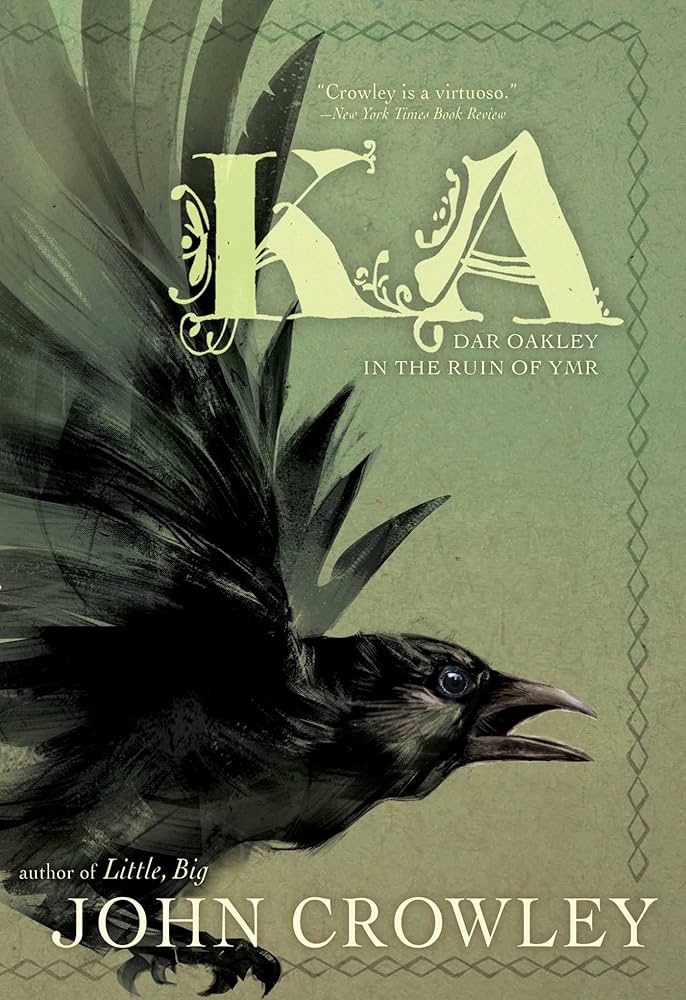
Ka: Dar Oakley in the Ruin of Ymr
Grade: A
Throughout his entire career, writer John Crowley has been a master at turning the simple into the sublime, the plain into the profound, little into big. Ka: Dar Oakley in the Ruin of Ymr, a late-career classic, may be his most impressive literary achievement yet: a universal fable that encapsulates the entirety of existence through the eyes of a humble bird.
That bird is Dar Oakley, a crow who never dies. Or, rather, Dar Oakley is a crow who gains the power to come back to life, traversing the underworld, constantly reborn. Through his many lives, he sees the rise and fall of humanity, from primeval society thousands of years ago to ecological decay in the not-so-distant future, telling his Tale to an unnamed dying narrator, who then tells the Tale to us.
Despite the fantastical subject matter, Crowley always keeps things realistic. He’s careful not to mythologize his main character, using plaintive language and subtle humor that offers a matter-of-fact perspective. Ornithologically speaking, Dar Oakley is a believable Corvus — just a crow, after all, only capable of surface-level observations, with daily escapades offering more psychological insight than any nature documentary ever could.
Anthropologically speaking, too, Dar Oakley’s path is interwoven with real people and events, like Brendan the Navigator’s voyage to the Atlantic, the American Civil War, or the brief period in the early 20th century when farmers used dynamite to kill crows. As he tries in vain to understand the ways of people, Dar Oakley becomes more like a person himself, though he is never anthropomorphized. It makes for a historical speculation that somehow doesn’t seem far-fetched, even when considering Dar Oakley is an immortal crow who can communicate with people.

That’s the great power of Crowley’s writing: he makes you believe in magic. There really is a Ka, a realm where Crows perceive the world their own way; and there really is an Ymr, where the things People believe to be true are true. And, in that great mysterious metaphysical way, there really is a Dar Oakley, brought to life by story, serving as a lesson for us readers and the unnamed narrator alike, who seems to be a stand-in for the elderly Crowley himself.
Above all else, Ka: Dar Oakley in the Ruin of Ymr is a terrific allegory, teaching us what it means to be human by teaching us what it means to be crow. Only a great book can change the way we view the world, and Ka certainly is that. But although the reading experience is undoubtedly a positive one, with the life-affirming poignancy that Crowley can write better than anyone, the themes are pessimistic and cautionary.
Dar Oakley’s multi-millennia story isn’t so much about eternal life as it is about the inescapable mysteries of death. By the end, it’s the only thing mankind and crowkind can share, and it’s where Ka inevitably leads. The last few chapters are beautifully abstract, as all Crowley endings are, with dreamy ambiguity that gives off the impression of dying for real; dead as dead, or something like it. I’ve re-read it many times, but the answers remain indecipherable and just out of reach. I, and Crowley, too, won’t truly understand what it all means until…well, you know.
I recommend this book very highly. There aren’t many novels like Ka: Dar Oakley in the Ruin of Ymr, and there certainly aren’t many writers like John Crowley. It’s reassuring that he’s still writing at such a high level so late in his career. He’s given his readers a real gift here — one of his finest works.
FURTHER READING:
Here are a few articles/reviews providing more insight on John Crowley’s Ka: Dar Oakley in the Ruin of Ymr:
- https://rrhorton.blogspot.com/2018/03/a-review-of-john-crowleys-ka.html
- https://mbc1955.wordpress.com/2018/10/19/considering-john-crowley-ka-dar-oakley-in-the-ruins-of-ymr/
- https://www.reddit.com/r/Fantasy/comments/c7n98i/ka_dar_oakley_in_the_ruin_of_ymr_by_john_crowley/
- https://jeroenthoughts.wordpress.com/2018/05/02/john-crowley-ka-dar-oakley-in-the-ruin-of-ymr-2017-review/
STRAY OBSERVATIONS (including SPOILERS):
- Communication is an important part of Ka: Dar Oakley in the Ruin of Ymr, as Dar Oakley is the first (only?) crow to learn how to “speak” with humans. This means he’s the first crow to have a name, which also means he’s the first to understand the concept of names. It’s a poignant observation of consciousness, how language can expand it, and how knowledge of a thing essentially creates the thing in question.
- As Dar Oakley understands new concepts in Ymr, we too understand the ways of Ka, namely through Crowley’s subtle re-imagining of language, where certain words take on different meanings: demesne, billwise, vagrant, one.
- While the exact learning process of Dar Oakley’s communication is never explained (“…I wrote down only what he told me, not how I learned to hear it”), he seems to only commune with spiritual types: indigenous shamans, a Celtic monk, a symbolist poet resembling Emily Dickinson, and the futuristic Crowley stand-in who provides Ka’s framing device.
- The book’s exploration of various cultures and belief systems reminds me of Crowley’s early sci-fi classic, Engine Summer (1979), which followed a similar tribe-hopping, quest-for-knowledge narrative structure. Ka, too, touches on themes of creation mythmaking, environmentalism and interpenetration, living on through something else.
- Profound observation: the best thing mankind has ever given crows are the dead bodies from our wars and battles. An endless supply of food, basically.
- Another profound observation: birds probably knew the world was round way before humans ever figured it out.
- Dar Oakley is amazed — and I’m sure other animals are, too — by People’s ability to think back to the past and ahead to the future.
- Ymr is pronounced “ee-murr,” right? Dar Oakley says it’s the sound people make, but I can’t think of any words it might be based on.
- Are the Small Ugly People that Dar Oakley encounters from the Crow Tribe’s lore the same as the fairies from Little, Big? And what’s the deal with the kidney stone of eternal life? The first time Dar Oakley stole immortality, it was in the form of a Crow’s Egg, nothing itself. The second time, with the Small Ugly People, it is nothing once again, though it certainly changed.
- The passages where Dar Oakley goes to the lands of the dead are the book’s most intriguing, even if they are the most ambiguous and abstract. Crowley’s prose in these sections becomes very symbolic, multi-layered, open for interpretation, taking influence from indigenous folklore, Dante’s Inferno and Orpheus and Eurydice. It’s hard to tell if Dar Oakley’s experiences in these different realms are real or imagined, dream or death. Seemingly, the afterlife reflects the beliefs of the believer.
- The final death in the story, that of the unnamed narrator, who doesn’t become prominent until the final section of the book (“Dar Oakley in the Ruin of Ymr”), is the one that’s hardest to decipher. He goes “there” guided by Dar Oakley, seems to commit suicide, finds the way shut, the forest empty, and is forced to return.
- Was it because he feared what comes after death, believing it to be nothing but a desolate, empty place? Was it because he went about it the wrong way, committing suicide and seeking out the afterlife intentionally? Was it because Ymr itself was dead, the realm of People, with no one believing such things anymore? Was Dar Oakley even real, or was he just a story created by People, or the narrator, to try to understand death? Was it all a dream?
- Whatever the answer, I love Crowley’s prose during the final pages, where death is compared to a dream. The reason we know we’re not dead is because we can wake up to know of it. But in true death, we will never ever wake to know of it. There will be no memory.
QUOTES FROM KA: DAR OAKLEY IN THE RUIN OF YMR:
- And then more, and then the rest: how it began, how it will end. Beginning here.
- “The moment had passed. There is a moment, and it passes; and it had.”
- How, he wondered, could you know the names of things, and not know the things?
- He could see farther than she could, but she could see things that he could not.
- “Oh,” said Dar Oakley.
- He saw the dead alive. Not in another land where People guess or dream they are, but all around, in the ordinary daylight lands poisoned by the living.
- Final Lines: What I thought I could see were the lithe, slow shapes of one or two Deer approaching in the mist: the real and common Deer of this world, as real as pain.
Discover more from Colin's Review
Subscribe to get the latest posts sent to your email.