
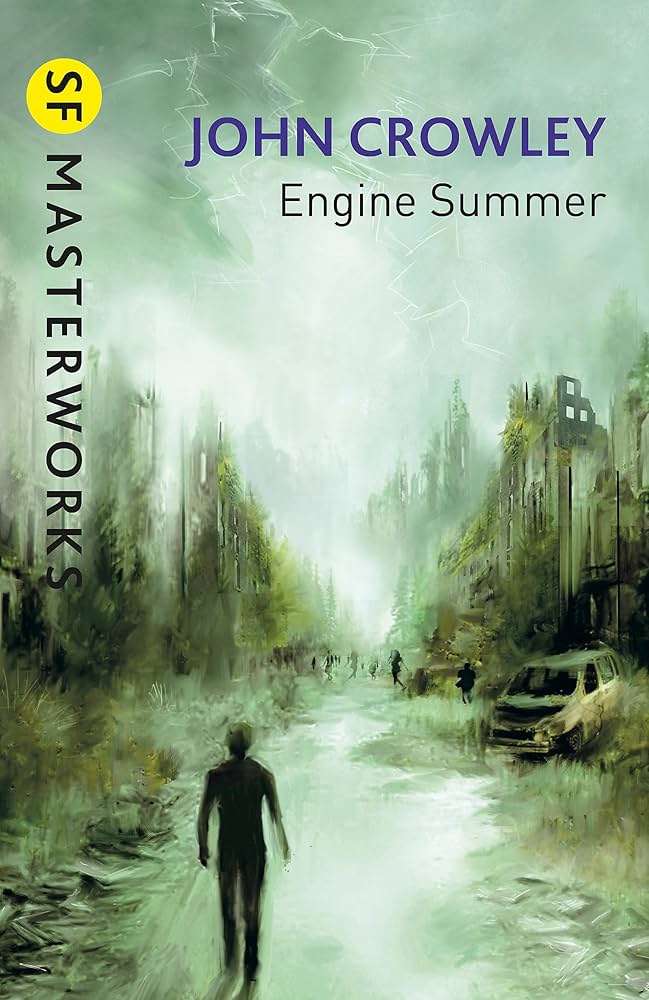
Engine Summer
Grade: A
American author John Crowley is a very talented writer. The way he constructs his stories — as ever-expanding narratives growing infinitely inward, forever beckoning the reader to read them all over again — is truly masterful. Those unique narrative talents become fully developed by his third novel, Engine Summer, a story-of-a-story that ultimately becomes fully prescient that it is, indeed, only a story.
Now, I will admit to ultimately not “getting” the story, or at least not all of it. There are many things about Engine Summer, particularly the ending, which remain elusive, even on subsequent re-readings. Yet even through the confusion, I can’t deny that the book is a magical experience. It’s always a joy to get lost in a world of Crowley’s creation, whether you can make sense of it or not.
In Engine Summer, the setting is Earth in the far, far future, in a post-post-apocalyptic version of America. But instead of sci-fi dystopia, the small societies found in Engine Summer are primitive and peaceful. Crowley crafts a dreamy and tranquil story, with beautiful writing and carefully crafted prose that never tries to subvert or obfuscate. The novel takes place approximately one-thousand years from now, and the “new” world is an idyllic place, though noticeably older than it once was.
Our main character is Rush That Speaks, a young boy born into a community of Truthful Speakers. His entire way of life is built upon meaning what you say and saying what you mean, which also means that he’s one of the most reliable narrators you’ll ever meet. Nevertheless, he can’t make us understand beyond our means: Rush explains what he can about his world, but Engine Summer generates its power from its consistent ambiguity and poetic sense of discovery. Crowley puts us right into the thick of this unfamiliar world, but never with enough clues to feel secure in our knowledge of it.
Not that the story is meant to be solved one way or another, anyway. Engine Summer is soothing and serene and psychedelic; all about the journey that Rush takes rather than the destination: as he visits other societies in search of knowledge, the main takeaways are what he learns about himself, rather than what he learns about the world around him.
If Engine Summer doesn’t seem to be about anything in particular, well, that’s because it isn’t. Or, rather, like many of Crowley’s novels, it’s about everything. The story depends on what the listener makes of it. And who’s telling it.

Just as I did with Little, Big, I immediately began re-reading Engine Summer as soon as I finished it. The elliptical ending pretty much requires it. Lo and behold, I still don’t know what to make of it. There are several elements that become clearer upon closer inspection, particularly the multi-layered narrative, but — similar to the ending of Little, Big — the concluding chapters will most likely always remain abstract to me.
That’s okay — Engine Summer’s main pleasures are in Crowley’s poignant, philosophical musings and the weirdly hypnotic atmosphere he creates. Still, it’s easy to want more: for a story so concerned about the nature of stories, the fact that Rush That Speaks only finds meaninglessness from his own story can feel somewhat unfulfilling. Then again, that’s precisely the point.
As dictated by Crowley’s ingenious, Möbius strip, self-referential narrative, the meaning is likely to change the next time around. Perhaps I’ll find more emotional resonance in Rush’s “romance” with Once a Day (even though Crowley’s futuristic society seems to be staunchly post-human when it comes to affairs of the heart). Or perhaps I’ll find a deeper understanding of the novel’s italicized interjections (even though I’m pretty sure the mysterious listener behind the curtain is a metaphorical stand-in for whomever is reading the book).
Or perhaps I’ll enjoy it simply for what it is: an elegant, erudite and esoteric sci-fi parable that puts you into a soothing trance, all deeper meanings be damned. Despite a few reservations, I’m comfortable calling Engine Summer a great book, one that can be enjoyed and interpreted in many ways. And I’ll be returning to it as many times as I need to, over as many lives as it takes.
FURTHER READING:
- Like much of Crowley’s work, Engine Summer is relatively unknown despite being so well-written. Here are a few write-ups that offer some valuable insights into what the book is all about:
- https://manyworlds.substack.com/p/john-crowley-engine-summer-1979
- https://jeroenthoughts.wordpress.com/2020/12/15/john-crowley-engine-summer-1979-review/
- https://ian-93054.medium.com/engine-summer-john-crowley-fcf79159ff4b
- https://mbc1955.wordpress.com/2014/12/28/considering-john-crowley-engine-summer/
- https://jericsmith.com/tag/engine-summer/
STRAY OBSERVATIONS (including SPOILERS):
- I realize I haven’t described the plot of this plotless novel in much detail. It is a travelogue of sorts, with Rush recounting his journey from his hometown of Little Belaire to visit other societies in search of knowledge. Along the way, he meets strange people, encounters strange technologies and learns about strange ways of life (though they only seem strange to us). That’s pretty much it, yet Crowley structures the book in a reader-friendly architecture (four sections, with about six chapters in each) that keeps us hooked and thoroughly entertained.
- Crowley’s handling of these futuristic societies is very consistent and realistic within the novel’s internal logic. Just like he did in his previous works (The Deep and Beasts), the world-building is fully fleshed out, especially on a cognitive level: several words have taken on completely new definitions (e.g., “cords,” “knots,” “saints,” “angels”), which is how Crowley’s far-future speculation becomes so immersive. It’s a book that teaches you how to read it as you go.
- My favorite parts of the book are the italicized interjections from the unseen listener, which are a fascinating mystery every time you revisit them, and the chapters that Rush spends hibernating with Blink, an old “saint” who teaches him about forgotten knowledge.
- Although Rush That Speaks is quite a humorless (and somewhat unemotional) narrator, the book is filled with comically poignant observations about how our modern technology will be seen in the next millennium: calendars and crossword puzzles are mystical sources of wonder; “Road” was a murderous invention that killed countless people; the national symbol of America was the buzzard. There’s even an easy-to-miss masturbation joke at the end of the second chapter of part four.
- Along the way, Rush falls in love with a mysterious girl named Once a Day. However, I feel their brief romance leaves much to be desired. Apart from Once a Day viewing him with total indifference, the concept of love itself doesn’t really seem to exist in this futuristic world. And because Rush’s obsession isn’t treated as some forbidden desire or forgotten emotion, it seems that their connection only serves as a catalyst to advance the plot. Crowley’s themes of love are much better in Little, Big.
- I noticed a few similarities between Engine Summer and Cormac McCarthy’s The Road (2006), not least of all the fact that Rush travels along the abandoned remnants of the interstate highway (known simply as Road). But there are a few other passages (pg. 105: ‘but which can never be put back again’) which seem to have directly inspired McCarthy’s observations about our dying world. I’d be very surprised if he had never read this book.
- In Engine Summer, the technological marvels of yesteryear are now just ancient junk, while the mundane stories of today have become the myths of tomorrow. It offers a thought-provoking examination on how we ascribe meanings, great and small, to the stories that manage to survive, on purpose or by accident. Something as unremarkable as a set of false teeth can become a lesson to live by in the next millennium, and something as simple as the sentience of a cat can become a kind of god.
- Crowley also examines how creation myths are created in another novel, Ka: Dar Oakley in the Ruin of Ymr (2017), which delves into similar themes of environmentalism and Gnosticism. The settings, too, are similar in their indigenous folklore philosophies.
- One of the book’s biggest mysteries is trying to figure out what happened to our 21st century society. In a way, we mirror Rush That Speaks (or, at least, the version of Rush That Speaks telling this story) in that we desperately want to know what happened to us.
- Engine Summer takes place many centuries after a calamity known as the Storm. Although the details are vague, it seems that some combination of man’s scientific hubris and toxic radio waves from TVs resulted in a mass extinction. The immediate aftermath, which includes the Great Co-op Belaire, the Long League of Women and the angel cities in the sky, is harder to decipher.
- The book’s biggest mystery is trying to figure out to whom Rush is telling his story — and what that means for Rush when his story is through. The answer seems to be that Rush, as we know him, is a kind of hologram or artificial intelligence that is neither alive nor dead: a consciousness that can be stored and experienced by others, but can only relay the story of his life up to the moment his consciousness was transferred to the machine. The person listening, then, is a descendant of the pre-collapse survivors, the technologically advanced humans who built floating cities in the sky to escape the calamities below.
- In a way, this means Rush has become an immortal story, a Saint, like he always wanted: the people of Laputa (it’s a city in the sky, duh) listen to him tell his life’s tale and try to learn the “ancient” ways of man. But the grand tragedy is that Rush will never know what happened to himself, the real Rush, who continued living after his snapshot of consciousness was downloaded. Did he return home? Did he grow old? He’s been telling his story for 600 years and every time he finds out this harrowing truth for the first time. He is trapped in Engine Summer forever — begin on page one, experience him all over again and try to gain a deeper understanding.
- Another theory I have is the possibility that Rush might’ve actually died. Mongolfier, the comical explorer from Laputa, draws a gun in the final chapters, but it never goes off. Perhaps that is why Mongolfier wanted Rush to close his eyes as the orb hovered above his head?
QUOTES FROM ENGINE SUMMER:
- Begin at the beginning; go on till you reach the end. Then stop.
- Sometimes the snake’s-hands in a story are the best part, if the story is a long one.
- But summer goes on, a small false summer, all the more precious for being small and false. In Little Belaire, we called this time — for some reason nobody now knows — engine summer.
- ‘Truthful speaking would be a simple way to tell the truth, if the whole truth were simple, and could be told.’
- ‘But littered all around this old ordinary world, scattered through the years by that smashing, lost in the strangest places and put to the oddest uses, are bits and pieces of that great sphere; bits to hold up to the sun and look through and marvel at — but which can never be put back together again.’
- I wondered if I’d ever see him again. I wonder if I ever did.
- Time, I think, is like walking backward away from something: say, from a kiss. First there is the kiss; then you step back, and the eyes fill up your vision, then the eyes are framed in the face as you step further away; the face then is part of a body, and then the body is framed in a doorway, then the doorway framed in the trees beside it. The path grows longer and the door smaller, the trees fill up your sight and the door is lost, then the path is lost in the woods and the woods lost in the hills. Yet somewhere in the center still is the kiss. That’s what time is like.
- Final Lines: Ever after. I promise. Now close your eyes.
Discover more from Colin's Review
Subscribe to get the latest posts sent to your email.