
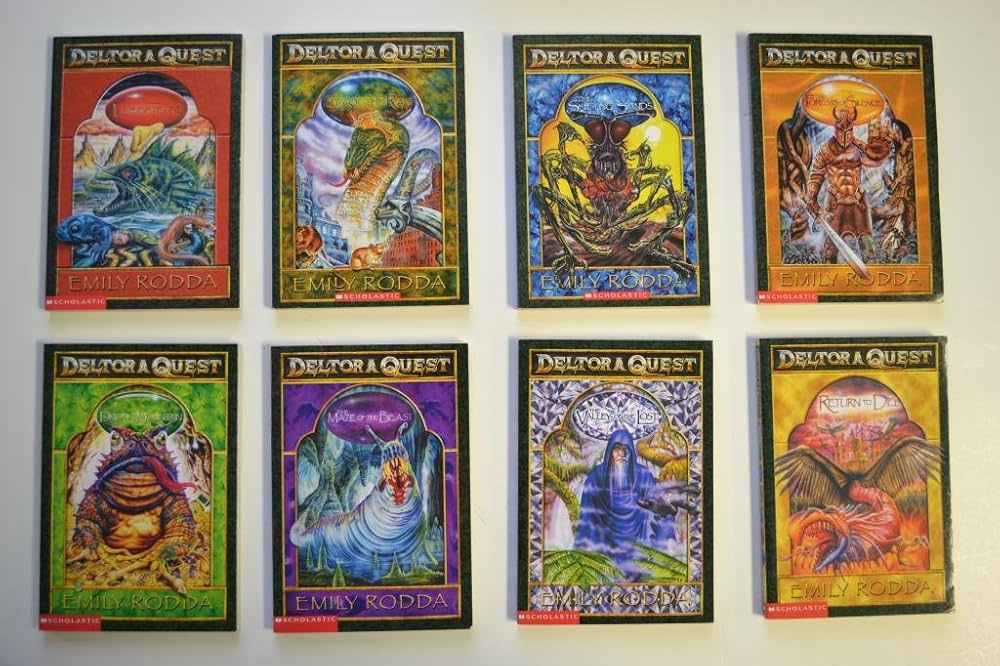
Deltora Quest
Grade: A-
When I was just a child, maybe seven or eight years old, on a whim at my elementary school’s book fair, I bought a copy of The Forests of Silence, based purely on the illustrations alone. That menacing, golden-armored knight on the front cover instantly captured my imagination, and the story within surpassed my highest expectations. Emily Rodda’s Deltora Quest began my lifelong love affair with reading, and for that, I’ll be forever grateful.
But revisiting Deltora Quest decades later, I expected to be disappointed. After all, this was a book series meant for children, specifically eight to 14-year-olds, and there was no way it could hold up to adult scrutiny and cynicism. So, imagine my surprise — and relief — when the eight original Deltora Quest books were just as good as I’d remembered. A core memory reignited and reaffirmed.
As high fantasy, Deltora Quest is world-building at its best. Even if the premise is basic, the execution is inspired — an evil, omnipotent, Sauron-like being known as the Shadow Lord overthrows the weakened royal family and takes over the land of Deltora, scattering the seven mystical gems from the magic Belt of Deltora and hiding them in seven dangerous places throughout the land. Three companions (Lief, Jasmine and Barda) set out to find the gems and rid their kingdom of the evil tyrant and his servants.

Deltora Quest separates itself from other young-adult fantasy series’ due to its unique settings. Each book is different, and each adventure is action-packed. Rodda’s writing sometimes suffers from a lack of humor, a too-serious tone and weak characterization, but the creatures she conjures up are extremely imaginative. There’s a reason why the Marc McBride-illustrated covers feature terrifying monsters instead of the main characters.
Likewise, the pacing is extremely tight, filled with a constant atmosphere of fear and suspense. Even though every book pretty much follows the same format — travel to perilous location, fight evil Guardian, retrieve gem — the diverse settings always keep things interesting, from Tolkienesque woodlands to dreamy Dune sandscapes to Hansel and Gretel witchcraft to Treasure Island high seas adventures.
It’s a very fun world to explore despite darkness lurking at every corner. And the darkness is handled so casually — so Australian, in fact — that the surprising amount of death doesn’t dampen the sense of adventure. Anyway, to offset the constant life-threatening situations, Rodda fills each book with a fun and clever assortment of riddles, puzzles and secret codes that keep readers on their toes. The payoffs are very rewarding, no matter how old you are.
And since I’m talking about rewarding payoffs, I must mention that the final book of the series, Return to Del, is by far the best installment. It’s truly an impressive piece of writing, young adult fiction or otherwise. Without revealing too much, there are about five or six twists in the book’s final act that are magnificently constructed and bring the entire series together in an extremely satisfying way. Rodda sticks the landing, and then some.
Which means it’s only natural to hunger for more Deltora Quest. Luckily, there are two sequels — the three-book Deltora Shadowlands and the four-book Dragons of Deltora — that continue the adventures of Lief, Jasmine and Barda and expand on the detailed Deltora mythology established in the original series. Devoted fans will enjoy these installments (Dragons, in particular) just as much.
And it’s a pleasure to still be a devoted fan after all these years. I greatly look forward to returning to Deltora again at some point in my life, and I doubt it’ll take another 20 years before I do so. I recommend these books to any fan of fantasy fiction, big or small.
FURTHER READING:
- Here are a few other reviews/articles/analyses that give Deltora Quest its due:
STRAY OBSERVATIONS (including SPOILERS):
- If I had to rank all eight Deltora Quest books from best to worst (i.e., “least best”), I think it’d go something like this: 1) Return to Del 2) The Maze of the Beast 3) The Shifting Sands 4) The Forests of Silence 5) The Valley of the Lost 6) The Lake of Tears 7) City of the Rats 8) Dread Mountain
- Now, if we’re ranking the seven Guardians from coolest to lamest, let’s go with: 1) The Glus 2) Reeah 3) The Hive 4) Gorl 5) The Guardian a.k.a. Fardeep 6) Soldeen 7) Gellick
- Maybe it’s an Australian thing, but Rodda’s naming convention leaves a bit to be desired. I guess because every name is unique, there’s no problem identifying the characters. But when all the characters have somewhat similar dialogue and emotion, the strange names are often their only definable traits.
- Rodda is at her best during the action sequences, which are very frequent in Deltora Quest. She has a direct yet detailed style that is easy to follow and easy to imagine. The tone remains remarkably consistent throughout every book, which is why not a single magical creature or setting — no matter how fantastic — feels out of place.
- J.R.R. Tolkien and J.K. Rowling are clearly Rodda’s biggest influences. The scope of Deltora is similar to Middle Earth, while some of the creatures bear resemblance to the fantastic beasts in Harry Potter (e.g., Reeah is like the Basilisk; the shape-shifting Ols are a cross between Boggarts and Dementors).
- Huge spoilers ahead, but I’ve got to tell someone: the successive plot twists of “Dain is the heir” to “Dain is actually an Ol” to “Doom is Jarred” to “Jasmine is Doom’s daughter” to “the Belt is in the wrong order” to “Lief is the true heir,” which comprises a seven-chapter stretch at the end of Return to Del, is wonderful storytelling. Each reveal is bigger than the next. No lie — it’s right up there with “The Prince’s Tale” chapter in Harry Potter and the Deathly Hallows.
- The second series, Deltora Shadowlands, is not as good as Deltora Quest, but it’s still a suitable and exciting follow-up, albeit a little disconnected. But the third series, Dragons of Deltora, is honestly just as good if not better than the original eight books — a darker series that features Rodda’s best writing and an epic, all-encompassing story that capitalizes on the entire mythology of all 11 previous books. The final book, The Sister of the South, is terrific.
- Apparently, there’s a Japanese anime adaptation of Deltora Quest, but I’ve never seen it, nor do I have any desire to. This is the type of story that exists best in the mind of the reader.
QUOTES FROM DELTORA QUEST:
- He knew that the Enemy is clever and sly, and that to its anger and envy a thousand years is like the blink of an eye.
- Twisted, barren peaks of clay rose beyond the lake like haunted things. There was not one green, growing thing to be seen. There was no sound but the dripping of water and the faint, squelching movements of mud. There were no smells but damp and decay. It was a place of bitterness, ugliness, misery, and death.
- His mind was suddenly filled with a vision of sandy wastes, of lowering, clouded skies. He saw himself, alone, among rippling dunes that had no ending. And he felt terror lurking, unseen. He gasped in horror.
- “Why do sculptors carve figures of stone, or shop owners list their wares upon their windows, or fools write their names upon trees and walls? To show what they love. To show what they own. To leave a message for all who pass by that way.”
- Each gem has its own magic, but together the seven make a spell that is far more powerful than the sum of its parts.
- One face alone loomed from its melting white. The face of Dain, in all his moods: timid, beseeching, tearful, laughing, teasing, dignified, brave…
- Final Line: He was well satisfied.
Discover more from Colin's Review
Subscribe to get the latest posts sent to your email.