
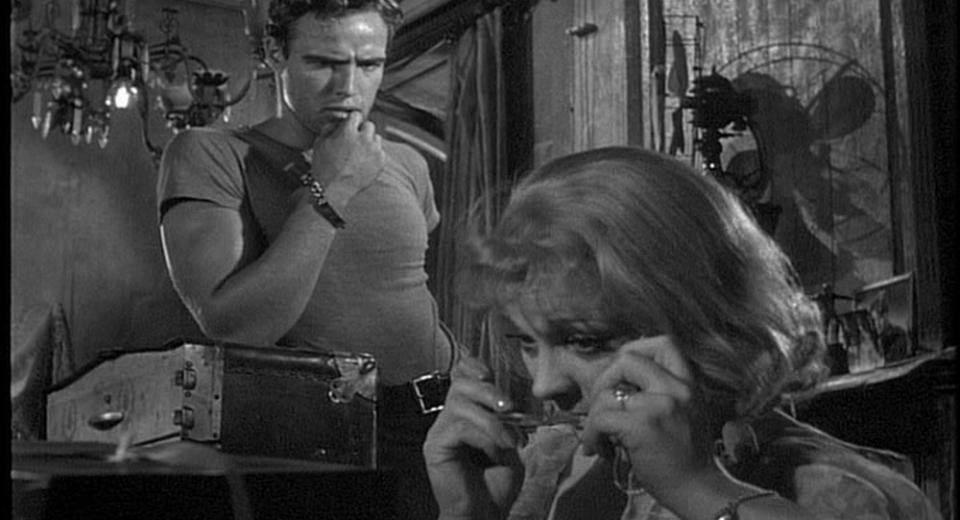
A Streetcar Named Desire
Grade: A
The film adaptation of Tennessee Williams’ Pulitzer Prize-winning drama, A Streetcar Named Desire, is raw and emotional, with some of the best acting you’ll ever see on stage or screen.
Directing:
Sometimes the best directing is the kind you hardly notice, and Elia Kazan (the director of the original Broadway production) keeps his cinematic embellishments to a minimum, all the better for putting the viewer right into the characters’ minds, the film mostly taking place in a crammed French Quarter apartment, deriving visceral visuals from artful restraint, like we’re spying on close-up scenes from real life: intimate, honest, uncomfortable.
Acting:
This is the type of acting that deserves to be seen in person: we’re not watching Vivien Leigh and Kim Hunter and Marlon Brando; we’re watching Blanche DuBois and Stella and Stanley Kowalski, characters brought to vivid life through perfect nuance and subtlety, an ensemble (retained from the original Broadway cast – sans Leigh, who starred in the London production) that delivers some of the most powerful performances in Hollywood history.
Writing:
Any fan of the theater will enjoy this dialogue-driven character study, a dramatic tour de force filled with eloquent language and timeless modern themes. And even if you’re not familiar with the source material or with plays in general, the intensity of the performances will keep you hooked, a slow-motion tragedy moving with the pace and grace of natural life.
Music:
Composer Alex North’s jazzy score — music of the steamy nighttime streets — is a perfect fit for the working-class Southern Gothic setting, smartly used for psychological commentary rather than schmaltzy sentimentalism. North never impedes, yet his contributions are an integral part of the film’s power.
Ending (SPOILERS):
Blanche DuBois’ “I’ve always depended on the kindness of strangers” is like Norma Desmond’s “I’m ready for my close-up, Mr. DeMille,” a tragic send-off that we sympathize but do not romanticize, leaving us emotionally ambiguous toward all three main characters, so much so that I even question whether Kazan’s final note of Code-enforced optimism should be interpreted closer to Williams’ original ending: who’s to say that Stella, having just resolved to leave Stanley for good, doesn’t come walking back down those stairs after the film is over, perpetuating the cycle of abuse rather than escaping it? However you read it, the film’s message is powerful, even if the play’s bleakness is preferred.
“Thousands of years have passed him right by, and there he is: Stanley Kowalski, survivor of the Stone Age, bearing the raw meat home from the kill in the jungle.” — Blanche DuBois
Why A Streetcar Named Desire gets an A
Classic Old Hollywood drama with some of the best acting ever, like Lumet’s 12 Angry Men (1957) or Preminger’s Anatomy of a Murder (1959).
Discover more from Colin's Review
Subscribe to get the latest posts sent to your email.