
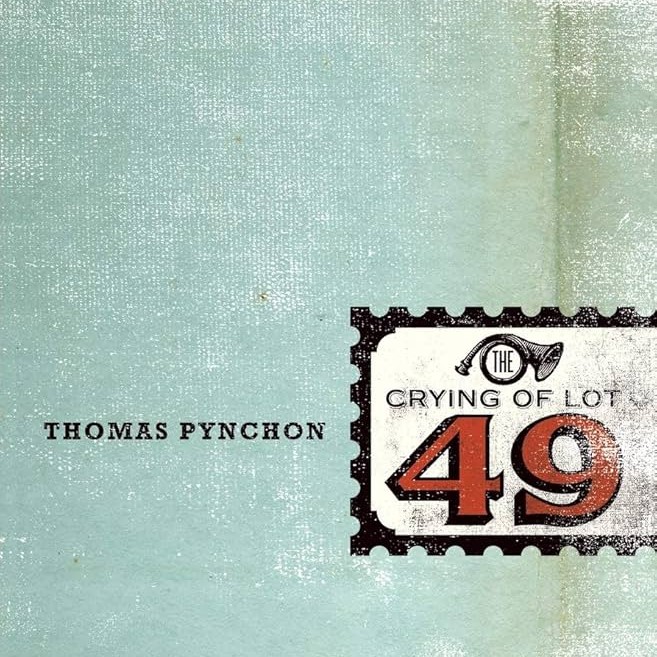
The Crying of Lot 49
Grade: A
Thomas Pynchon’s The Crying of Lot 49, originally published in 1965, is only 155 pages long but contains enough esoteric, encyclopedic knowledge to fill a book a couple-three times over. Infinitely expansive, with a masterful command of language and rhetoric, just the sheer amount of stuff that Pynchon includes is incredible.
From a distance, the storyline is simple: a stoned Southern California everywoman named Oedipa Maas is named executor (or she supposes executrix) of her ex-lover’s estate. Sorting through his will, she finds that he owns pretty much the entire town, including a weapons manufacturing plant and a cigarette company that uses bone dust in its filters. It isn’t long before Oedipa uncovers the potential existence of two secret postal service systems that have been at war with each other since the 16th century. Once you zoom in further, the plot grows absurdly and exponentially complex, following all the interconnected chaos, all the way down to the molecular level.
Then again, the plot isn’t really the point; it’s all about the prose. Admittedly, this is a very difficult yet very rewarding read. Pynchon’s writing is like 1940s bebop jazz or a Bob Dylan song circa 1965: rhythmic and lyrical, spiraling, a dense collection of free-flowing sentences filled with rapid-fire wordplay and obscure references, deriving slapstick out of the sublime, and vice versa. Once you grow accustomed to the singular style, The Crying of Lot 49 reveals itself to be a hilarious satire and a thought-provoking commentary on our paranoid postmodern times.

The book is also a metanarrative about the very art of communication itself. With Pynchon, the medium is always the message: everything in Lot 49, from its stylistic pastiche to its nonsensical narrative panache, is a creative experience only possible via the written word.
It’s the kind of story that demands to be read in specific ways. Puns in every paragraph. Inside jokes and syntactic non-sequiturs. Cultural, historical and scientific allusions that require background research. Always be prepared to re-read and flip back and forth.
All the while, Pynchon’s inventiveness never slows down, only gains momentum. There are Beatlesesque musical numbers. A five-act Jacobean revenge play. An in-depth discussion on entropy by way of the Maxwell’s Demon thought experiment. We feel as hysterical as Oedipa, who digs deeper into conspiracy but comes no closer to the truth. Even when she seems close to proving the existence of Tristero — a secret society of bloodthirsty couriers, whose existence might be the key to unlocking everything — the more lost everything seems.
In the end, The Crying of Lot 49 is about how meaningless and paradoxical the universe really is. But that doesn’t make it a boring place: no, Pynchon’s writing is too fun for that. How could you not be entertained by a world so patently absurd? Despite the cynical outlook, Lot 49 never takes itself too seriously, which when coupled with the page count makes it the perfect entry point into Pynchon’s body of work.
It may not be as all-encompassing as the impenetrable Gravity’s Rainbow (1972, his next novel) or as emotionally stirring as Mason & Dixon (1997, his fifth), but The Crying of Lot 49 endures as one of Pynchon’s most intellectually stimulating literary experiments. It is a great book. Even more important, it is a fun one.
FURTHER READING:
- Some insightful analyses on Thomas Pynchon’s The Crying of Lot 49, that gets into far more detail than I possibly can:
STRAY OBSERVATIONS (including SPOILERS):
- I recommend reading with a laptop or smartphone close by, so you can get some background info on all the references you might not understand. I learned a lot from reading this book, like who Jay Gould, Lamont Cranston, Remedios Varo and James Clerk Maxwell are. Not exactly necessary, but it provides some interesting context.
- Pynchon’s literary influences include Vladimir Nabokov, James Joyce and Herman Melville, which are more apparent in his debut novel, V. (1963). The Crying of Lot 49 is where he has completely amalgamated these influences into his own indistinguishable style — a real-world example of entropy. This is where the term “Pynchonesque” is born.
- Like many Pynchon works, Lot 49 comes with its own pseudo-soundtrack. Musical references include The Beatles, Karlheinz Stockhausen and Bartók’s Concerto for Orchestra, along with lyrics to songs made up for the novel.
- There are also made-up movies, like Cashiered, a 1930s adventure-on-the-high-seas film about a young boy who, along with his father and dog, secretly fight for the British army in a submarine. At the conclusion of Chapter 2, the movie builds to a violent, tragic, graphic, shocking (literally) end with no survivors.
- Another highlight: the five-act Jacobean revenge drama called The Courier’s Tragedy, which — like The Murder of Gonzago play-within-a-play in Shakespeare’s Hamlet — curiously mirrors the main action. The play lasts 10 pages, with an extremely detailed plot that no onstage production could realistically bring to life. Once again, the violence is extremely graphic — almost profound, somehow.
- I’m not sure I truly grasp the scientific concept of entropy, but I do understand it — or at least feel like I understand it — in relation to Lot 49. Oedipa’s quest to extract meaning from the mundane, separating what is and isn’t, is a great metaphor for this theme. She is Maxwell’s Demon personified, a thought experiment that is philosophically plausible but, as Oedipa’s fruitless quest to make sense of the cartoonish world around her proves, quite impossible.
- The entropic metanarrative of Lot 49 is that Pynchon’s dense writing style forces us, like Oedipa, to desperately search for meaning in the text. The book’s opening sentence disorients us right away (see the first bullet in the QUOTES section below): How are we supposed to know what’s important? What info should we pay attention to? How can we be sure we’re not ascribing meaning to the meaningless?
- There exists the possibility that the whole Trystero conspiracy is a sick cosmic joke made directly at Oedipa’s expense. She’s so paranoid that it isn’t far-fetched that the universe itself is out to get her. Is Pierce Inverarity (her ex-lover) even dead? Did he make her executrix of his will, leading her down an endless rabbit hole of secret postal service networks, just for shits and gigs? Perhaps.
- By the end, Oedipa is no closer to discovering what anything means, yet she remains obsessed by what she can’t possibly know. Her life is falling apart, and she finishes the book anxiously awaiting the auction of Pierce’s stamp collection, which may or may not lead to a Trystero bidder. Like Oedipa, we’re left in a permanent state of ambiguity and uncertainty: everything — and nothing — is possible (and impossible). Entropy wins again.
- Real-life theory that Thomas Pynchon worked for the CIA: the Dr. Hilarius character tests the effects of LSD on unsuspecting housewives, much like MKUltra.
- Secret histories. The unseen power of the picket fence. L.A.’s desert origins. Pynchon will return to the themes of Lot 49 throughout his career, most similarly in the burn-out capers Vineland (1990) and Inherent Vice (2007). Try if you can to visualize Lot 49 as a Paul Thomas Anderson film. Put on some Pavement while you’re at it (Stephen Malkmus’ lyrics are pretty Pynchonesque, if you ask me).
QUOTES FROM THE CRYING OF LOT 49:
- One summer afternoon Mrs Oedipa Maas came home from a Tupper-ware party whose hostess had put perhaps too much kirsch in the fondue to find that she, Oedipa, had been named executor, or she supposed executrix, of the estate of one Pierce Inverarity, a California real estate mogul who had once lost two million dollars in his spare time but still had assets numerous and tangled enough to make the job of sorting it all out more than honorary.
- That only made her laugh, out loud and helpless: You’re so sick, Oedipa, she told herself, or the room, which knew.
- She had never executed a will in her life, didn’t know where to begin, didn’t know how to tell the law firm in L.A. that she didn’t know where to begin.
- Meanwhile, back in the torture room, the cardinal is now being forced to bleed into a chalice and consecrate his own blood, not to God, but to Satan.
- Having been since age 7 rigidly instructed in an eschatology that pointed nowhere but to a presidency and death, trained to do absolutely nothing but sign his name to specialized memoranda he could not begin to understand and to take blame for the running-amok of specialized programs that failed for specialized reasons he had to have explained to him, the executive’s first thoughts were naturally of suicide.
- “Nearly three weeks it takes him,” marvelled the efficiency expert, “to decide. You know how long it would’ve taken the IBM 7094? Twelve microseconds. No wonder you were replaced.”
- Cammed each night out of that safe furrow the bulk of this city’s waking each sunrise again set virtuously to plowing, what rich soils had he turned, what concentric planets uncovered?
- “When those kids sing about ‘She loves you,’ yeah well, you know, she does, she’s any number of people, all over the world, back through time, different colors, sizes, ages, shapes, distances from death, but she loves. And the ‘you’ is everybody. And herself. Oedipa, the human voice, you know, it’s a flipping miracle.”
- Final Lines: The auctioneer cleared his throat. Oedipa settled back, to await the crying of lot 49.
Discover more from Colin's Review
Subscribe to get the latest posts sent to your email.