
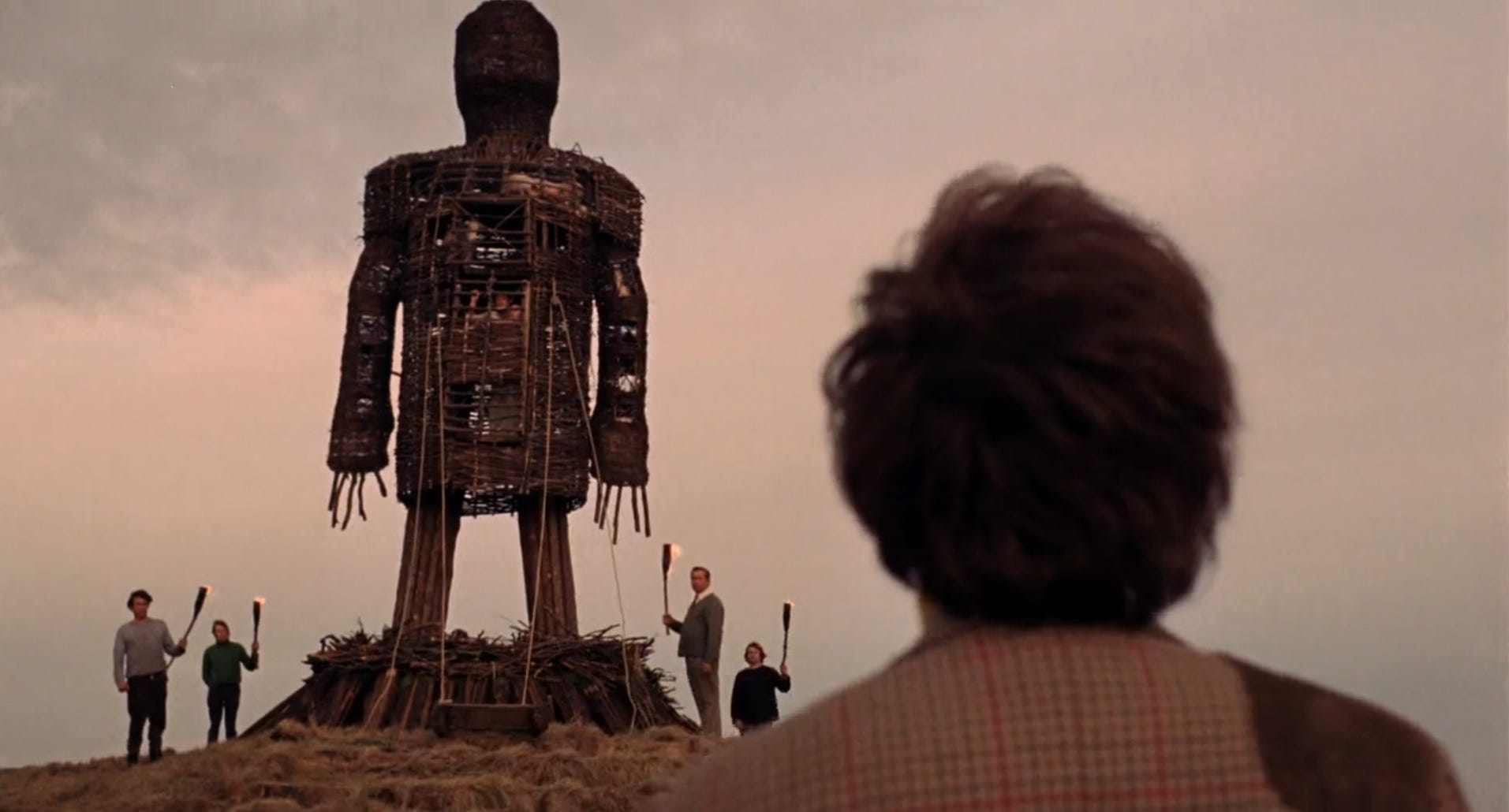
The Wicker Man
Grade: A-
The Wicker Man (the original Wicker Man, that is; not the infamous 2006 “Not the bees!! Not the bees!! Aaaargh!!! THEY’RE IN MY EYES!!!!!” remake starring Nicolas Cage) is one of the best B-movies ever made. Noticeably cheap and slightly cheesy, yet artfully practical and eerily atmospheric, this British folk horror cult classic — truly a “cult” classic, thoroughly researched and accurate in its detail, a believable depiction of a modern-day Druid sect — is an incredibly entertaining film despite its disturbing, idiosyncratic subject matter.
Directing:
In The Wicker Man, a British police sergeant (Edward Woodward) heads to a remote Scottish isle to investigate the disappearance of a young girl. The film makes excellent use of its small budget, slowly building fear by light of day, with strange pagan imagery and batshit supporting characters, creating a bizarre yet realistic occult atmosphere. For a devout Christian like Sgt. Neil Howie, being trapped on an island with freaky heathens who worship the old gods, dance naked around the maypole and know nothing about the missing young girl is a terrifying nightmare.
Director Robin Hardy dispenses with traditional jump scares and slasher gore, opting for something more psychological and spiritual. The film’s period-accurate, pastoral imagery, the logical world-building, the sheer Britishness of it all, are all influences on 2010s art-horror auteurs like Robert Eggers and Ari Aster. Where Hardy differs is in the total absence of cinematic embellishment: the low-budget cheapness adds to The Wicker Man‘s charm, even if it somewhat caps the film’s ambition.
Acting:
I wouldn’t say the cast of the film overacts; rather, their offbeat mannerisms are entirely appropriate for the unnerving idolatry that The Wicker Man wants to convey. The cast is chosen as much for their eccentric appearances as for their acting chops, or lack thereof.
Edward Woodward (famous for the 1967-’72 British spy series, Callan, and whose stern face somewhat resembles Daniel Craig) plays Sgt. Neil Howie, the honourable constable, who can’t believe how fucked up things are on Summerisle, yet who remains admirably, albeit foolishly, devoted to his strong Christian morals. His unintentionally hilarious, full-throated scream of “OH JESUS CHRIST!!!!” as he’s being dragged into the titular effigy is iconic.
Meanwhile, the memorable ensemble of pagan wackos all do a fine job creeping out the constable: Aubrey Morris (of A Clockwork Orange fame) is the sneering gravedigger who buries animals in the cemetery and plants trees decorated in dried, human skin; Britt Ekland is the busty innkeeper’s daughter who performs one of the hottest stripteases in cinematic history; and Christopher Lee, known for his campy performances in Hammer Film Productions from Dracula (1958) to The Legend of the 7 Golden Vampires (1974), is the formidable Lord Summerisle, a 6’5” wild-haired messianic modern-day Druid more impressive than Saruman and Count Dooku combined.
Writing:
At its core, The Wicker Man — written by Tony-winning playwright Anthony Schaffer, based on the 1967 horror novel, Ritual, by David Pinner — is an intriguing whodunnit. Sgt. Howie’s investigation into the disappearance of young Rowan Morrison is well structured, amplifying mystery rather than suspense. Even though you can see the story’s twists coming from a mile away, the folk-horror atmosphere is consistently spooky and unique. Plus, The Wicker Man benefits from some underrated black comedy. The conviction with which the people of Summerisle deliver their kooky beliefs, countered by Sgt. Howie’s utter disgust and incredulity, is played for laughs rather than scares.
Unfortunately, there is some choppiness to the narrative progression, as there are a few plot elements that were cut in post-production, such as flashback scenes about Howie’s marriage and expository scenes about Lord Summerisle’s origins. As a result, The Wicker Man isn’t as cohesive or intricate as it could be, though the 90-minute runtime is the perfect length for such a weird little tale.
Music:
A large reason for The Wicker Man’s authenticity is its progressive folk soundtrack, which is whimsically corny yet appropriate for the presentation. Not only is this a distinctly British film; it’s also a distinctly 1970s film. The various songs (performed by a one-off ensemble called Magnet, composed by American songwriter Paul Giovanni) feature acoustic guitar, lyre, violin, jaw harp and recorders — a prog fan’s wet dream. And if that doesn’t get you off, the landlord’s daughter performing a striptease over those instruments certainly will.
Ending (SPOILERS):
The elaborate ruse of Rowan Morrison’s disappearance is revealed to be a complex conspiracy that the entire community has planned from the start, all with the goal of ensnaring Sgt. Howie as a human sacrifice (he fits their gods’ four requirements: he came of his own free will, he’s a virgin, he enforces the law of a King, and he is a noble fool). Yes, it’s a very complicated ploy that requires a few leaps in logic — everything worked out perfectly! — but the horror of the final scene makes it all worth it, even if we already knew that the entire film was leading up to this moment anyway.
Sgt. Howie’s fruitless last-ditch efforts to preach the ways of Christ are filled with realistic hysteria, while Lee channels his inner Saruman to deliver a conclusive chilling monologue containing the immortal lines: “We confer upon you a rare gift these days: a martyr’s death. Come. It is time to keep your appointment with the Wicker Man.”
There is no salvation, at least none that we are privy to, for Sgt. Howie. He burns alive in the giant wicker man, which is the film’s most awe-inspiring prop. The final shot of the burning effigy, followed by the sight of the ancient, unforgiving, impossibly red Sun (echoes of Herzog’s Aguirre, the Wrath of God), is a terrific note to close a horror movie on. Likewise, the extremely pessimistic undertones — perhaps the old gods are real; perhaps good is no match for evil; perhaps Christiandom is as much a sham as Celticism — offer thought-provoking questions that most B-movies never dare to ask. The ending of The Wicker Man is easily the best part of the film.
“Do sit down, Sergeant. Shocks are so much better absorbed with the knees bent.” — Lord Summerisle
Why The Wicker Man gets an A-
A horror movie cult classic, though not without its inherent low-budget flaws. As fun as Carpenter’s Halloween (1978) and Coscarelli’s Phantasm (1979). As thought-provoking as Eggers’ The Witch (2015). Better than Aster’s Midsommar (2019).
Discover more from Colin's Review
Subscribe to get the latest posts sent to your email.