
Doubt
Grade: A-
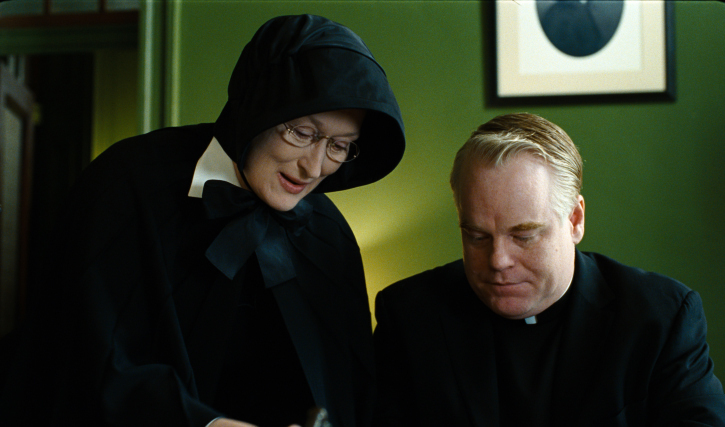
Starring Meryl Streep, Philip Seymour Hoffman and Amy Adams — and with Viola Davis delivering a tour de force in only one scene — Doubt is a masterclass of acting. The film is an engrossing drama that completely derives its power from the intricate performances. A few more notes on Doubt:
Directing:
Playwright John Patrick Shanley brings his 2004 Tony-winning stage drama to the big screen, and his talents easily transfer over to the new medium. He directs Doubt as if it were a play, with static camera movement and extensive use of close-ups to amplify the actors’ emotional authenticity. Partly due to the Irish-Catholic setting and the cold-platinum cinematography of Roger Deakins, the film takes on the sorrowful atmosphere of Clint Eastwood’s Mystic River — an investigation that’s more about the investigators than the mystery. Even though Shanley is propped up by a bevy of talent, his directorial work here is leagues better than his previous film (Joe Versus the Volcano way back in 1990).
Acting:
Doubt contains some of the best acting you’ll ever see, notably Hoffman as the suspicious priest who goes toe-to-toe with Streep’s stern, no-nonsense nun. Every scene in the film is essentially a back-and-forth dialogue, with very little in the way of traditional “action,” yet Doubt remains incredibly engrossing due to the powerful performances. The fiery one-on-one arguments between Hoffman and Streep should be studied in theater class. And comedy class — Doubt is surprisingly filled with hilarious dry humor.
Writing:
The storyline of a charismatic, friendly priest accused of child abuse is difficult yet ever-relevant dramatic territory. Shanley’s story takes the premise and twists it in a very clever direction: the accuser comes from within the priest’s own order and bases the accusation on only a biased hunch. Furthermore, the victim (a young black student) is left out of the loop. Despite the subject matter, this isn’t a religious film by any means, as it ultimately doesn’t matter what profession the central characters belong to: Doubt is a parable about skepticism and certainty and the internal struggles that result. The performances are fantastic, obviously, but the story itself — and the calculated dialogue — would be compelling in any setting with any collection of actors.
Music:
Howard Shore’s soundtrack is filled with lush yet foreboding strings, which fit perfectly within the film’s November setting. Once again, the amount of top-tier talent that Shanley has assembled for Doubt is unbelievable.
Ending (SPOILERS):
In the end, we take the side of Sister Aloysius (Streep) over Father Flynn (Hoffman), as the evidence she presents, or lack thereof, is quite damning. Either way, Flynn essentially gets a promotion after he resigns, as he’s transferred to a larger parish: the system is irreparably broken. But I was a little confused by the film’s final scene, in which Sister Aloysius weeps in self-doubt of her accusations (“I have doubts!” she cries). She had been so consistent in her vitriol throughout the entire film that I felt this was a little out of character.
“Doubt can be a bond as powerful and sustaining as certainty.” — Father Brendan Flynn
Why Doubt gets an A-:
For acting alone, Doubt would garner an A+. However, the final scene leaves a little to be desired — an ending which works better on stage than in film.
Discover more from Colin's Review
Subscribe to get the latest posts sent to your email.