
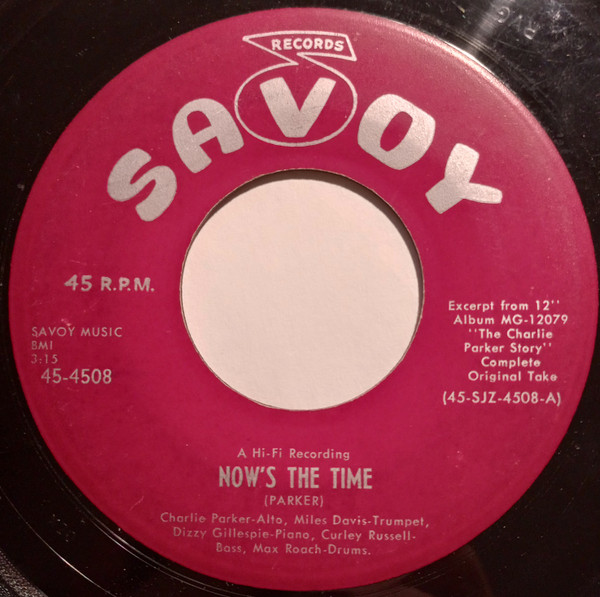
40. “Now’s the Time” by Charlie Parker
Not every Charlie Parker song is a complex and speedy blast of bebop. Case in point: the slowed-down blues of “Now’s the Time,” in which Parker’s quintet patiently take turns soloing over a relatively simple chord progression. Of course, in typical Parker fashion, there is plenty of spontaneity to keep the listener on their toes, such as Dizzy Gillespie’s ominous piano (!) interjections, Max Roach’s foreboding backbeat and a young Miles Davis delivering a trumpet solo that flutters on the edges of atonality. And, as always, Bird steals the show with a saxophone solo that dazzles despite the relative restraint.
39. “Taurus” by Mary Lou Williams
Mary Lou Williams’ Zodiac Suite is best taken as a singular work of art — a beautiful blur of contrasting colors. And “Taurus,” the album’s second track, is a microcosm of everything that the Zodiac Suite has to offer. From key change to key change, chord to chord, note to note, the song is completely unpredictable. Williams strategically uses silence and a scaled-back approach to keep us in complete suspense — we never know which direction the music will take.
38. “You Won’t Be Satisfied (Until You Break My Heart)” by Ella Fitzgerald and Louis Armstrong
Only a few artists have the distinction of featuring in three consecutive Colin’s Review Best Songs of the Decade lists, and Louis Armstrong — i.e., the most influential jazz musician of all time — has been a steady fixture since day one. Equally recurrent is Ella Fitzgerald, who by this point in her career was already the best (or at least second-best) female jazz singer ever. All of which makes the tender and playful duet “You Won’t Be Satisfied (Until You Break My Heart)” a musical match made in heaven. Armstrong is as charismatic as ever, and Fitzgerald’s tone was never purer — the song is easily one of their best collaborations.
37. “Groovin’ High” by Dizzy Gillespie
“Groovin’ High” is a terrific example of all that trumpeter Dizzy Gillespie — and, by extension, bebop itself — has to offer. The solos are complex and elaborate, with surprising melodies and key changes that come out of nowhere. Each note leads the listener somewhere new, but the real beauty of this contrafact (based on Paul Whiteman’s 1920 standard “Whispering”) is its rhythmic simplicity. Even though bebop was radically different than every form of jazz that came before, the old adage still rang true: it don’t mean a thing if it ain’t got that swing.
36. “Yardbird Suite” by Charlie Parker
One of several Charlie Parker standards to make the Colin’s Review Best Songs of the 1940s, the “Yardbird Suite” boasts one of the best ensemble performances that Bird ever took part in. Every musician gives a peak performance: bassist Vic McMillan and drummer Roy Porter lay down an incessant, throbbing beat filled with nervous energy; Parker, Miles Davis and Lucky Thompson craft beautiful solos seemingly at odds with the high-strung rhythm section; pianist Dodo Marmarosa colors the track with unique phrasings; and electric guitarist Arvin Garrison steals the show with a blistering showcase that comes out of nowhere. There’s so much layered invention throughout “Yardbird Suite” that every listen will reveal something new.

35. “Guitar Boogie” by Arthur Smith
The greatest instrumental country song since Eck Robertson’s “Sally Gooden,” Arthur Smith’s 1946 hit single “Guitar Boogie” is also one of the greatest guitar performances ever captured on tape. Repurposing Texas boogie-woogie rhythms into a proto-rock ‘n’ roll manifesto, Smith and his Rambler Trio take us a on a scorching six-string tour of modern sounds in country and western music. The song is an essential piece of Americana.
34. “La vie en rose” by Édith Piaf
One of the most famous French songs ever recorded, the reputation of Édith Piaf’s “La vie en rose” is well deserved. Even if you don’t speak the language, it’s hard not to be moved by a melody as great as this. Likewise, Piaf’s stirring voice transcends the chanson genre altogether. This is popular music at its peak: graceful, delicate and immensely powerful all at once.
33. “These Foolish Things” by Lester Young
No saxophonist, or rather, no musician in jazz history played as relaxed as Lester Young. His feathery, free-flowing style is on full display in his rendition of “These Foolish Things,” a soothing display of bebop improvisation in its purest form. Similar to Coleman Hawkins’ masterful “Body and Soul” (the second-best song of the 1930s), Pres calmly solos around the outskirts of a familiar melody and creates a new musical language. His unique brand of jazz sounds lazy on the surface yet still demands attentive listening.
32. “Cancer” by Mary Lou Williams
Pianist Mary Lou Williams traded ideas with the likes of Dizzy Gillespie, Thelonious Monk and Miles Davis — you could say she’s largely responsible for the birth of bebop. Then again, one listen to her 1945 masterpiece Zodiac Suite and you’ll find that she transcended the genre altogether. One of the highlights from the LP (and perhaps the one that best showcases her unique sense of song structure) is “Cancer”: a mysterious piece of impressionism that is brilliantly abstract. Mainly a solo piano piece, the song starts and stops and climbs and searches and never fully resolves; an evocative example of why Williams was your favorite modernist composer’s favorite modernist composer.
31. “A Night in Tunisia” by Dizzy Gillespie
Jelly Roll Morton, one of jazz’s purported inventors (a claim he himself popularized), considered the “Spanish tinge” an essential ingredient of the genre. Flash forward over 30 years to Dizzy Gillespie’s most famous tune, “A Night in Tunisia,” which generates its greatness from the hot-and-heavy Afro-Cuban rhythms at its core. The 1946 recording of the song for RCA Victor features great ensemble interplay: an iconic walking bass line from Ray Brown, ghostly vibraphone accompaniment from Milt Jackson, interlocking clave cadences from J.C. Heard and one of Gillespie’s most piercingly mysterious trumpet solos. Taken as a whole, “A Night in Tunisia” is an electrifying standard that remains true to jazz music’s origins while also displaying just how far jazz had come.
Jump to a Section