
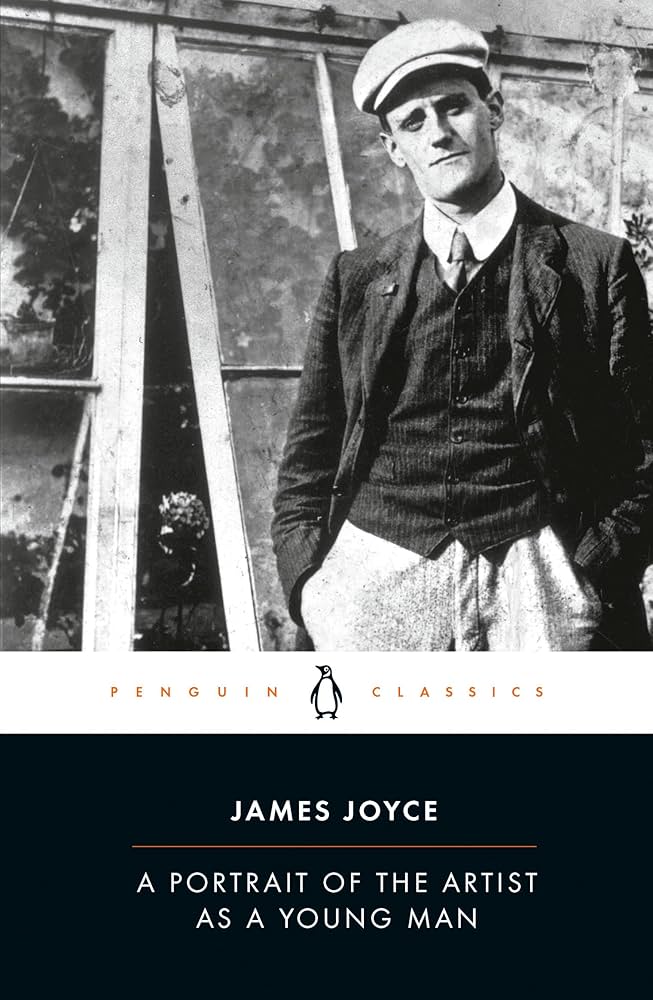
A Portrait of the Artist as a Young Man
Grade: A
Filled with awe-inspiring prose exploring the subconscious mind, A Portrait of the Artist as a Young Man is James Joyce’s pseudo-autobiography about growing up in turn-of-the-19th-century Ireland. Standing in for the author is fictional alter-ego, Stephen Dedalus, a character we come to know inside and out, whose consciousness is expressed so clearly and so deeply that the hyper-specific experiences become universal. In a way, the novel reads more like a painting than a plot, with Stephen’s inner thoughts laid bare, boldly visible for all to see — autobiography as work of art.
But Portrait isn’t just an autobiography of character; it’s also an autobiography of aesthetic. As Stephen grows from early childhood to adolescence, Joyce’s writing style evolves from primitive stream of consciousness to lush metaphor-laden prose, conscious of its own creation. There are two concurrent coming-of-age stories in Portrait: that of the artist and that of the art, and it’s brilliant to see how they go in equal yet opposite directions. The language becomes more complex and informed, more beautiful, yet Stephen personally becomes more pretentious and cynical.
However, it’s important to remember that, ultimately, Stephen is not Joyce. He is just a character, not a one-to-one representation of the author, and the book contains a good deal of humor that can be easy to miss. Joyce pokes fun at his younger self’s lack of direction, his shameless self-absorption and self-seriousness (and diabolical horniness): all problems that could’ve been avoided had he just been better at talking to women. To this end, Portrait is indeed a portrait — Stephen is unchanging throughout the novel, a still image on a canvas, while the real Joyce outgrew such flaws.

Yet despite all the fascinating modernist and postmodernist parallels, the myriad literary references and the aesthetic questions of artistic authenticity, the main reason for Portrait‘s greatness is simply the splendor of Joyce’s writing. I don’t know any other books where the literal first page is the best, but Portrait’s stream-of-consciousness depiction of Stephen’s earliest memories is truly sublime in its simplicity, capturing the initial self-awareness of oneself better than any story I’ve ever read.
And even though nothing else tops the book’s opening pages, which consists of Stephen’s toddler years and first homesick semester at boarding school, it’s a testament to Joyce’s abilities that Portrait remains narratively compelling the whole way through, despite the best parts coming so early. The whole novel is filled with beautiful metaphors and free association: thoughts becoming colors, colors becoming sounds; Joyce consistently finding the words to describe the indescribable.
We end up knowing Stephen better than he knows himself, but how well do we know him really? In the end, a portrait of Stephen — or Joyce, or anyone — is really a portrait of all the things that shaped him. Institutions like family, education, sex, religion and the arts, whether accepted or rejected, make an indelible mark on Stephen’s consciousness, becoming part of him forever. And so, after spending much of his young life trying to forge his own identity, Stephen reaches a final epiphany: acceptance of unknowing is the first step to truly knowing. And now that he, Joyce, knows this, he can finally forge within the smithy of his soul the uncreated conscious of his race.
In other words, the modernist masterpieces Ulysses and Finnegan’s Wake do not exist without the wonderfully self-reflective, slightly self-indulgent, powerfully soul-searching classic that is A Portrait of the Artist as a Young Man. It’s a great read, but consider it as a primer, or prerequisite, for even greater literary masterpieces to follow.
FURTHER READING:
Joyce scholars can tell you a whole lot more about A Portrait of the Artist as a Young Man than I, so here are a few insightful articles/reviews/analyses about the novel:
- https://campuspress.yale.edu/modernismlab/a-portrait-of-the-artist-as-a-young-man/
- https://literariness.org/2020/12/31/analysis-of-james-joyces-a-portrait-of-the-artist-as-a-young-man/
STRAY OBSERVATIONS (including SPOILERS):
- Divided into five chapters, Portrait is relatively plotless yet adheres to a distinct narrative cycle of rise and fall: each chapter finishing with Stephen coming to a triumphant intellectual epiphany, only for the next to begin with a ritual of shame, failure and humiliation. The story flows very well, never becoming too tedious, even though much of the traditional coming-of-age “action” (e.g., the Joyces losing their family home, moving to Dublin, etc.) happens offscreen.
- Packed with literary, political, religious and geographical references pertaining to Joyce’s direct personal experience, there is plenty to analyze in Portrait. However, I think the best way to enjoy the book is to simply let the prose wash over you, without pause — yes, even the Latin sections. A base understanding of Ireland, Catholicism and Charles Stewart Parnell is all that’s required. Flipping back and forth between the hundreds of footnotes will interrupt the spell and make reading seem like a chore.
- Once you grow accustomed to the narrative rhythm — how young Stephen’s memories bounce back and forth in time, essentially unbound, thinking a hundred thoughts during a split-second daydream on the rainy rugby pitch — the story becomes easy to comprehend. Relatively easy compared to other modernist works.
- Stephen is at his most sympathetic in Chapter 1, when he’s just a shy, lonely kid attending Clongowes Wood College circa 1891. The world both fascinates and frightens him: the rough and tumble schoolyard code of his classmates, the strict education of his Jesuit teachers, the heated political arguments that ruin family dinners — to whom should he entrust his faith? It’s no surprise that he falls in love with words, with language itself, in all its poetic and powerful rhetoric.
- It’s also no surprise that his earliest childhood memories are of songs and nursery rhymes. He is destined to become an artist. But is it only because the author has made it so?
- Who is the real Stephen? Do we ever really get to know him? He keeps everyone at arm’s length, missing the forests for the trees, so full of artistic introspection that he never really takes a good look at improving himself. It’s a fascinating character study, with more emphasis on “study” than “character.”
- Stephen has good taste: he’s an avowed fan of Percy Blythe Shelley, Lord Byron, William Blake, Henrik Ibsen and Alexandre Dumas, to name a few.
- After spending much of Chapter 2 in the throes of masturbation shame and self-hating post-nut clarity, finally succumbing to temptation and sleeping with a prostitute, Stephen renounces his sinful ways after listening to a long, graphic, intense sermon about Judgment Day, the Four Last Things and the exact dimensions of Hell. One of the best passages of the book, enough to scare any sinner straight — no wonder he swears off whores forever.
- But then there’s the girl at the beach at the end of Chapter 4, who is so beautiful that Stephen swears off religion forever, dedicating his life instead to chasing divine beauty through art. An ass so fine that it has to be a sign from God. One of the best passages in Joyce’s entire career.
- Stephen is frequently contradicting himself, which shows how solipsistic and out of touch he is with the real world. Things that make sense in his artistic mind don’t materialize when put into practice. For instance, who swears off religion after receiving a so-called sign from God? Likewise, his aesthetic theories and hifalutin debates with his college-mates in Chapter 5 aren’t meant to be taken seriously. These were among my least favorite passages — did people really talk like this? This is the “loves the smell of his own farts” phase of the artist’s journey.
- I don’t think I really grasp Stephen’s personal aesthetic theory, which seems to be cribbed from St. Thomas Aquinas anyway. Basically, he opines that a work of art can only be beautiful if it is culled directly from the initial spark of inspiration in the artist’s mind, like fading coal in reverse, art for art’s sake, a formal design separate from any personal influences. It’s an intriguing thought, but it is disproven by the very conception of A Portrait of the Artist as a Young Man.
- Kinda funny that Stephen only creates one artwork the entire novel, a poem in villanelle form dedicated to his unrequited crush, Emma Clery. It’s a fine poem, albeit a tad overwrought. Ironic that the form adheres to his aesthetic theory, but the content is all culled from personal influences.
- The book’s ending is interesting: Stephen talks with his friend, Cranly, about his decision to leave Ireland and pursue an artistic career as a writer. As Cranly tries to convince him to stay, fearful that Stephen will feel alone and abandoned, for the first time all book — for the first time in his life, really — Stephen empathizes with his fellow man: “Of whom are you speaking?” Cranly is really talking about his own fears.
- With this, Joyce as omniscient narrator effectively drops out of the book, finishing off with Stephen’s diary entries, which are filled with false starts and scattered thoughts. Ingeniously, it shows that Joyce has learned his lesson, now ready to write about other characters (e.g., Leopold and Molly Bloom in Ulysses) in a profound manner. Meanwhile, Stephen carries on as a character, still learning, still not quite there, though at least the journal shows he’s finally doing some self-reflection. Beautiful the way the art and the artist have now divulged. Open-ended — 10 years of self-imposed exile in Trieste to reflect and compose Portrait. Read Ulysses next.
- How many other artists have the balls to make an autobiographical work so early in their career? Furthermore, how many have the talent to pull it off, with a style so singular that the audience actually wants to know how the artist developed that style? Kendrick Lamar’s second album, good kid m.A.A.d city (2012), and Charlie Kaufman’s third screenplay, Adaptation (2002), come to mind.
QUOTES FROM A PORTRAIT OF THE ARTIST AS A YOUNG MAN:
- Once upon a time and a very good time it was there was a moocow coming down along the road and this moocow that was coming down along the road met a nicens little boy named baby tuckoo…
- But you could not have a green rose. But perhaps somewhere in the world you could.
- For some time he had felt the slight changes in his house; and these changes in what he had deemed unchangeable were so many slight shocks to his boyish conception of the world. The ambition which he felt astir at times in the darkness of his soul sought no outlet.
- He wanted to meet in the real world the unsubstantial image which his soul so constantly beheld.
- —Tennyson a poet! Why, he’s only a rhymester!
- His soul, as these memories came back to him, became a child’s soul again.
- —Imagine some foul and putrid corpse that has lain rotting and decomposing in the grave, a jellylike mass of liquid corruption. Imagine such a corpse a prey to flames, devoured by the fire of burning brimstone and giving off dense choking fumes of nauseous loathsome decomposition. And then imagine the sickening stench, multiplied a millionfold and a millionfold again from the millions upon millions of fetid carcasses massed together in the reeling darkness, a huge and riding human fungus. Imagine all this and you will have some idea of the horror of the stench of hell.
- He heard the choir of voices in the kitchen echoed and multiplied through an endless reverberation of the choirs of endless generations of children: and heard in all the echoes an echo also of the recurring note of weariness and pain. All seemed weary of life even before entering upon it.
- The sad quiet greyblue glow of the dying day came through the window and the open door, covering over and allaying quietly a sudden instinct of remorse in Stephen’s heart.
- Final Lines: 27 April: Old father, old artificer, stand me now and ever in good stead.
Discover more from Colin's Review
Subscribe to get the latest posts sent to your email.