
Shadow of a Doubt
Grade: A
Alfred Hitchcock has famously gone on record stating that his 1943 classic, Shadow of a Doubt, is his personal favorite Hitchcock film. It’s a fine choice: the movie perfectly fuses small-town wholesomeness with dark psychological material, adding a horrific relatability not often found in the rest of his work.
Directing:
Shadow of a Doubt takes Hitchcock to suburban Santa Rosa, California, where an old-fashioned “boring” American family — the Newtons — receives an unexpected visit from their charming Uncle Charlie (played by Joseph Cotten), who is revealed to be on the run for a series of psychotic murders back east. Each sequence fades to black before the next one starts, carefully building the suspense through episodic development, the picturesque setting gradually uncovering its own secrets as the plot thickens. Probably a direct influence on David Lynch’s Blue Velvet.
Still, Hitchcock keeps things light and fun, and fully revels in exploring an ordinary town and its ordinary people. You can really feel his earnestness: sure, the Newtons’ obliviousness to the true nature of their Uncle Charlie is quite satirical, but never are the characters treated with contempt or disdain. Shadow of a Doubt is not a critique of small-town values; it is an authentic adulation.
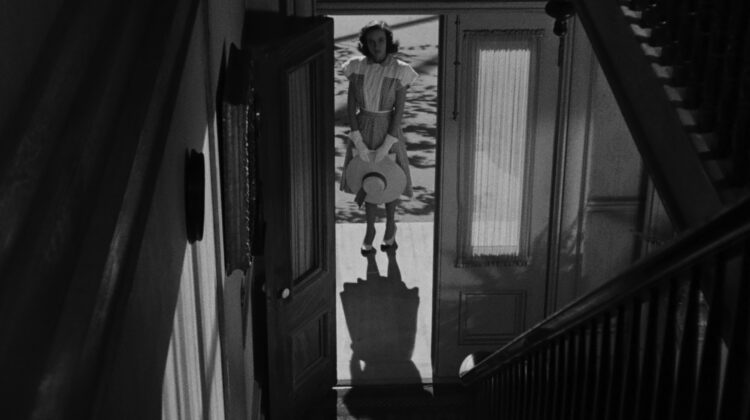
Uncharacteristic setting aside, Shadow of a Doubt remains a Hitchcock film through and through. The film noir shadows of the staircase; the canted Expressionist camera angles; the all-enveloping zoom-ins and zoom-outs — all meticulously engineered to maximize cinematic tension. Even though the repeated “waltzing widows” motif isn’t wholly necessary (it references no prior scene, and it masquerades as a “mystery” when it’s really just a MacGuffin), the film is masterfully contrived.
Acting:
Joseph Cotten plays Uncle Charlie as an unrepentantly emotionless psychopath: handsome and charismatic to everyone else; extremely unnerving to us viewers, who are in on the “secret” from basically the opening frames. It’s one of Cotten’s finest performances, and he believably shows us how easy it’d be for a killer like him to assimilate into society. He’s one of Hitchcock’s most memorable murderers.
Cotten’s foil is the perky niece, Charlotte “Charlie” Newton, played by Teresa Wright. Her performance fits right in the mold of the classic Hitchcock Woman: virtuous and beautiful, yet vulnerable and helpless to the terrible situation she is trapped in. She is both tempted by and terrified of her Uncle Charlie, a strange relationship that Wright totally sells.
The rest of the cast — notably Henry Travers as Young Charlie’s father — is chosen for their small-town stereotypes: a delightful bunch of caricatures that provide a colorful contrast to Shadow of a Doubt’s creepy atmosphere.
Writing:
Shadow of a Doubt’s screenplay was written by Alma Reville (Hitchcock’s wife), Sally Benson (author of Meet Me in St. Louis) and Thornton Wilder (Pulitzer Prize-winning playwright of Our Town), based on a story by Gordon McDonell, a combination that completely nails the Norman Rockwell-style Americana that Hitchcock wanted to convey. Folksy humor and modernist horror are both given equal shine.
Even though the plot falls apart when you give thought to the real-life implications (e.g., it’s quite implausible and paradoxical that Young Charlie would agree to keep Uncle Charlie’s past a secret, especially when Uncle Charlie is openly trying to murder her), the story stays consistent within in its own set rules. The “Merry Widow Murders” MacGuffin sets the thriller in motion, and all the drama is generated from the ambiguous, semi-incestuous relationship between the two Charlies. The lighter aspects of the film are perfectly necessary to offset such dark subject matter.
Music:
Dimitri Tiomkin’s orchestral score is low and brooding, with distinct Russian overtones (inspired by Dmitri Shostakovich, perhaps). A lurid waltz lurks in the background, gets stuck in the head, unleashed when the paranoia can no longer be ignored — a great soundtrack that matches the emotions onscreen.
Ending (SPOILERS):
I’m a defender of Hitchcock’s abrupt, rug-pull, darkly comic, semi-throwaway endings, but Shadow of a Doubt causes me to reach for an interpretation that I may be reading too much into. But I’m willing to give him the benefit of the…er…doubt that there’s more here than meets the eye.
For one, there is the final showdown between the two Charlies, in which they each make one final dumb decision: as Uncle Charlie is preparing to leave town forever, Young Charlie gets on the train with him, and he tries one last time to murder her. But in a last-second change of heart, it appears that Uncle Charlie “lets” Young Charlie kill him instead, throwing him into an oncoming train, telling her to wait for the locomotive to pick up enough speed. The editing becomes quick and jittery, and it happens so fast that the viewer gets whiplash. Hitchcock brings the intriguing psychology of each character to a crescendo in a matter of seconds — cynicism that is easy to miss.
And then there’s the brief epilogue: at Uncle Charlie’s funeral, he is hailed as a hero by his family, who is still unaware of the truth. Young Charlie, meanwhile, with a handsome husband-to-be on her arm, is glumly content to keep her uncle’s secret. Perhaps her worldview and faith in humanity will be shattered forever — how can she ever return to the romantic, mundane, happily-ever-after lifestyle that she desperately wanted to escape at the film’s beginning? Is she now cursed to live as a killer, like her monstrous uncle? Despite the comedic brevity of the ending, has Hitchcock tricked us into feeling sad that Uncle Charlie died, in turn identifying with Young Charlie’s love for him? Did his nihilistic philosophies have merit?
Hitchcock forces us to reckon with several difficult questions after a supposed “happy ending,” and he cruelly doesn’t give us enough time to contemplate their meaning. If we should feel sad for anyone, it’s Young Charlie, who really isn’t so young anymore. The small town remains oblivious. Life goes on for the rest of the world. She is the only one who has changed (possibly for the worse). The end.
“You live in a dream. You’re a sleepwalker. Blind. How do you know what the world is like? Do you know the world is a foul sty? Do you know, if you rip off the fronts of houses, you’d find swine? The world’s a hell. What does it matter what happens in it? Wake up, Charlie. Use your wits. Learn something.” — Uncle Charlie Oakley
Why Shadow of a Doubt gets an A
The relationship between the main characters is one of Hitchcock’s most complex dynamics, providing an unspoken horror that is perfectly undercut by the film’s sincere small-town sentiment. If the overall storyline was a tad more believable, Shadow of a Doubt would be an A-plus.
Discover more from Colin's Review
Subscribe to get the latest posts sent to your email.