
A Matter of Life and Death
Grade: A
The British filmmaking duo of Michael Powell and Emeric Pressburger (collectively known as “The Archers”) are among the greatest and most underrated directors of the 1940s. Their 1946 metaphysical classic, A Matter of Life and Death, is the most underrated picture in their entire filmography, with vibrant visuals that must be seen to be believed. The movie joins The Life and Death of Colonel Blimp (1943), Black Narcissus (1947) and The Red Shoes (1948) to make up one of the best single-decade runs that any filmmaker…or, filmmakers, rather…has ever had.
Directing:
In A Matter of Life and Death, a lovelorn Royal Air Force pilot jumps from his damaged bomber without a parachute and miraculously survives, escaping the afterlife on a technicality. Or did he? Not many films of the ’40s have such a high fantasy premise, but it’s all brilliantly brought to life through some of Powell & Pressburger’s most beautiful imagery.
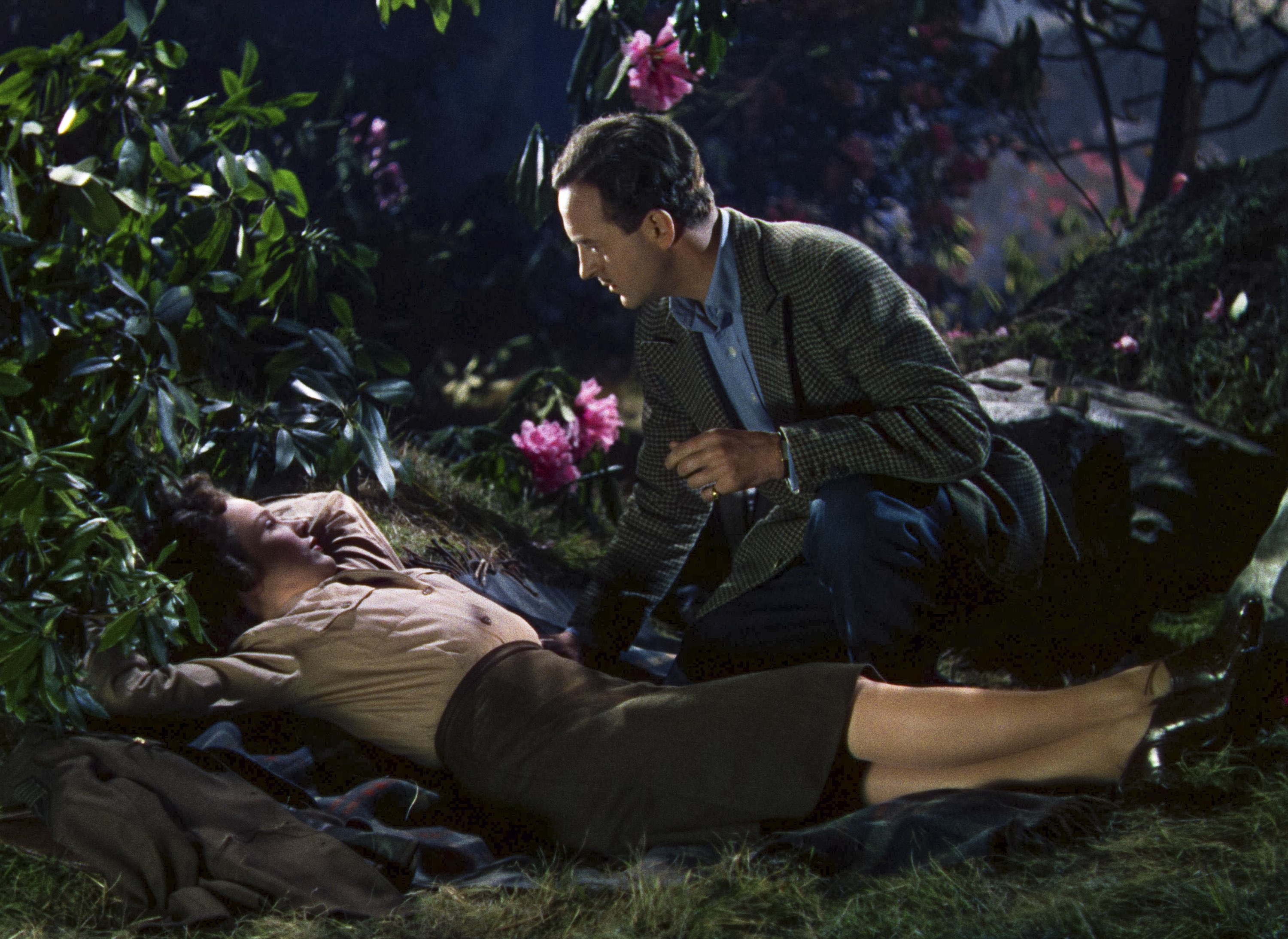
The afterlife scenes take place in ghostly, pearly, black-and-white, with vast, modernist set designs that would make Jean Cocteau proud. In particular, the 106-step Stairway to Heaven is one of the most impressive props you’ll ever see. On the flip side, the scenes that take place in the real world are filmed in hypervivid Technicolor. Cinematographer Jack Cardiff (who would also work with The Archers on Black Narcissus and The Red Shoes) captures everything so clearly that “reality” seems surreal. Can such colors — radiant reds, dazzling yellows, intense blues — even exist in nature?
There are so many great scenes and virtuoso displays (e.g., the desolate beach, the camera obscura, the freeze frames in which time stands still) that it’s hard to believe A Matter of Life and Death was released all the way back in 1946. From a technical standpoint, the movie is only matched by the best of Akira Kurosawa and Stanley Kubrick.
Acting:
David Niven (of Pink Panther fame) stars as Squadron Leader Peter David Carter, a half-dead Air Force pilot who faces his metaphysical conundrums with a whimsical sense of dry British humor. Kim Hunter (of A Streetcar Named Desire fame) plays June, the beautiful American nurse who falls in love with him. And the inimitable Roger Livesy, who needs no introduction, plays Dr. Reeves, a gregarious neurologist who steals every scene he is in.
The entire cast is great, but Livesy’s larger-than-life screen presence — even in a supporting role — is what really lends the film its human element. He is the anchor on which we can pin our emotions. Of course, such a commanding performance is expected when dealing with one of the best actors ever.
Writing:
For a fantasy movie, A Matter of Life and Death is remarkably grounded. The narrative is logical and organized; easy to follow despite its heady themes. And even though I wish Powell & Pressburger had explored the story’s baked-in existential questions with more psychological depth, I also applaud them for playing it straight. The movie is a swooning, sentimental romance at heart, driven by witty dialogue and well-developed character relationships. It’s basically the British cousin to Frank Capra’s It’s a Wonderful Life, another fairy tale released in 1946.
Music:
His fifth collaboration with Powell & Pressburger, Polish composer Allan Gray once again delivers a rich orchestral score, with several memorable motifs befitting of the film’s two distinct settings. Notably, the ominous, angular piano melody that signifies “the other world” is a perfect encapsulation of the afterlife’s atonal ambiguity. Gray’s music drifts dreamily, eerie and romantic, always matching the visuals.
Ending (SPOILERS):
Just as he is undergoing a complex brain surgery in the real world, Peter goes on trial in the Other World, defended by a recently deceased Dr. Reeves. Inside an impressive, cavernous set, a large jury of fallen British and American soldiers and nurses looks on. Here, the story somewhat devolves into a nationalist debate over British vs. American values. While this social commentary was very relevant in the immediate aftermath of World War II, I do wish the film hadn’t strayed from the far more interesting philosophical topics established earlier on. An argument over greatest Western superpower is not a matter of life and death, and it’s a theme that doesn’t always feel worthy of the film’s otherworldly visuals.
Anyway, Peter ultimately wins his trial thanks to Dr. Reeves’ tremendous oratorial skills. At the same time, his neurosurgery is successfully completed by a doctor who looks exactly like the prosecutor from the afterlife. Does this mean all the transcendental visions took place entirely in his head? Not necessarily. The return of a previously missing book in the film’s final scene (plus several earlier scenes in the Other World that are seen without Peter’s point of view) indicate that A Matter of Life and Death truly believes in its fantasy. Just like Peter truly believes in his love for June.
In the end, love is all that matters — a universal message shared with Christopher Nolan’s Interstellar (2014). I was hoping for a little more existentialism, but both films manage to nail the happy, sappy, semi-forced, romantic conclusions.
“One is starved for Technicolor up there!” — Conductor 71
Why A Matter of Life and Death gets an A
Enduring fantasy like Fleming’s The Wizard of Oz (1939). Lovable schmaltz like Capra’s It’s a Wonderful Life (1946). Extraordinary color like Kurosawa’s Ran (1985).
Discover more from Colin's Review
Subscribe to get the latest posts sent to your email.