
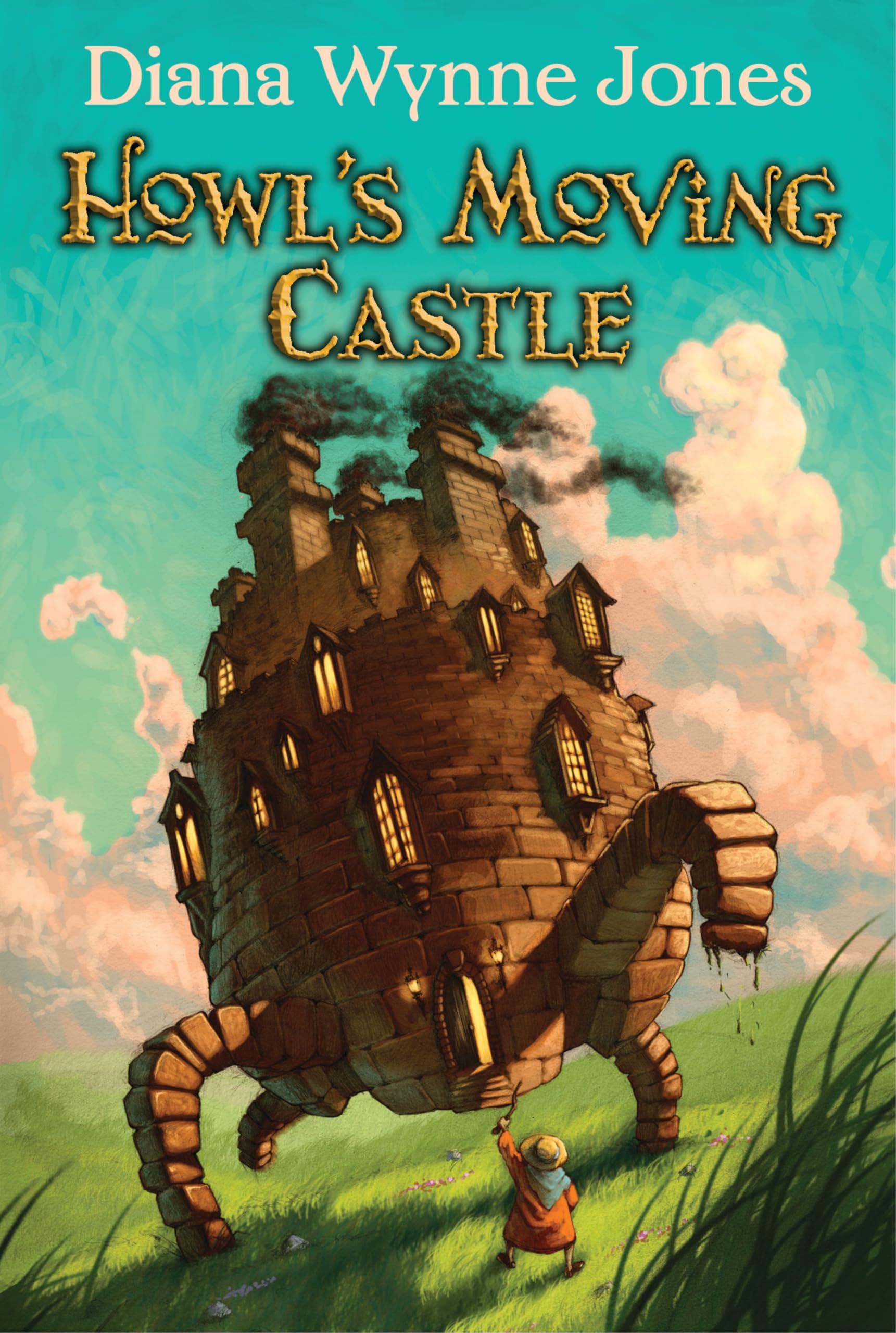
Howl’s Moving Castle
Grade: B
I have tried many times and many ways to enjoy Howl’s Moving Castle. I’ve seen the 2004 Hayao Miyazaki film adaptation probably 10 times (both the English dub and original Japanese audio, by the way). And now I’ve read British author Diana Wynne Jones’ original 1985 young-adult novel. Just like the film, it tells an imaginative coming-of-age fantasy that is very sweet but also very slight.
Set in the made-up land of Ingary, which features Kings and Princes, witches and wizards, scarecrows and fire demons, magic spells and seven-league boots, Howl’s Moving Castle is a novel filled with warmth and whimsy. Its hero is Sophie Hatter, the eldest of three sisters, a self-depreciating “ordinary” girl who longs for love but believes herself destined for disappointment. One day, after she unwittingly charms the vain, handsome, charismatic wizard Howl, the jealous Witch of the Waste curses Sophie and turns her into an old woman. Sophie takes it in stride, ends up settling in the enchanted titular domicile and spends the rest of the story serving as Howl’s pseudo-grandma.
Howl’s Moving Castle is a very comforting read. Jones does a great job crafting a fully realized fantasy world that bears all the hallmarks of a classic Hans Christian Andersen fairy tale. Her prose is simple and declarative. She establishes a tone and sticks with it. Despite the magical elements, there is never a sense of danger: Sophie—and Jones, by extension—is only interested in simple domesticity, for better or worse.
Likewise, the characters all serve a function, and most of them have memorable, defining traits. Calcifer, the fire demon, is charmingly mischievous. Howl, the self-absorbed wizard, is charmingly conceited. And Sophie, the resilient problem-solver, is charmingly demure. That’s indeed a lot of charm. Thankfully, Jones never lets things get too cutesy. However, the overall storyline—which doesn’t feature a lot of action or conflict throughout its 400 pages—becomes a bit tedious. I can see why others would enjoy the novel’s friendly, peaceful nature, but I found there to be quite a few boring passages.
To me, Howl’s Moving Castle is like a still-life painting purchased from a garage sale. You got it because it’s pretty. It’s job is to add color to the room, not make some grand artistic statement. A pleasant handcrafted ornament: well-written, well-meaning, but a little bland. A nice book—and film—for falling asleep to: cute, calming and completely inconsequential.
FURTHER READING:
- For some other perspectives on Howl’s Moving Castle, here are a few great articles/reviews/analyses that go into more depth about the book:
- https://dearauthor.com/book-reviews/overall-b-reviews/b-minus-reviews/review-howls-moving-castle-by-diana-wynne-jones/
- https://jeroenthoughts.wordpress.com/2023/03/02/diana-wynne-jones-howls-moving-castle-1986-review/
- https://bookloverssanctuary.com/2022/01/17/book-review-howls-moving-castle-diana-wynne-jones/
STRAY OBSERVATIONS (including SPOILERS):
- Despite the B grade, I’d still recommend Howl’s Moving Castle as a good book for younger readers. Jones’ simple yet wonderfully detailed prose encourages curiosity and imagination, and the story’s rather unique point of view (Sophie is a 17-year-old girl transformed into a 70-year-old woman) offers valuable lessons on aging and empathy.
- To me, the most interesting passages of the book revolve around Howl’s origins. The castle contains a portal to Wales that I wish was explored in further detail.
- The film is quite different than the book, as Miyazaki adds several elements—such as war, time travel and bird-monsters—that don’t exist in Jones’ novel. In addition, several characters are changed, combined or removed. Although both the film and the book have the same problems with pacing, I slightly prefer the book, which is more focused and consistent in its storytelling.
- In both works, however, the ending comes too quick, with the resolution of romance between Sophie and Howl feeling a bit forced. The happily-ever-after resolutions are described in a whirlwind, and all plot threads are abruptly completed in the final couple pages. The lack of a dénouement gave me whiplash.
- Jones has written two additional novels set in the Howl’s universe (though Howl and Sophie are not the primary characters): Castle in the Air (1990) and House of Many Ways (2008).
QUOTES FROM HOWL’S MOVING CASTLE:
- The rule was: Lose your temper, lose a customer. She had just proven that rule. It troubled her to realize how very enjoyable it had been.
- As a girl, Sophie would have shriveled with embarrassment at the way she was behaving. As an old woman, she did not mind what she did or said. She found that a great relief.
- “I know where all past years are, and who cleft the Devil’s foot.”
- “I assure you, my friends, I am cone sold stober.”
- Final Lines: “I don’t mind, as long as I can come and go,” Calcifer said. “Besides, it’s raining out there in Market Chipping.”
Discover more from Colin's Review
Subscribe to get the latest posts sent to your email.