
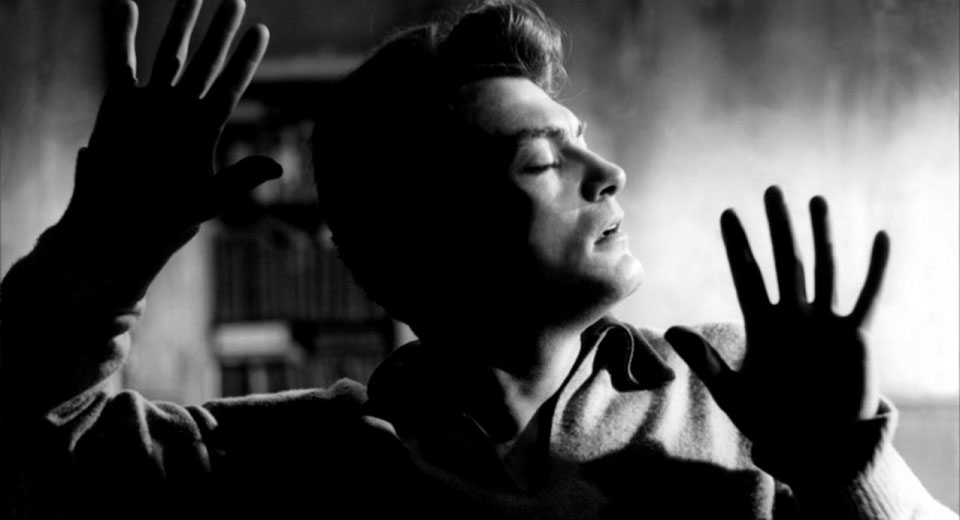
Orpheus
Grade: A-
This 1950 surreal fantasy from painter/poet/playwright/director Jean Cocteau is an experiment in pure cinema, in which Cocteau uses a variety of avant-garde filmmaking techniques to transpose one of the most famous ancient Greek myths to the modern day. A few more notes on Orpheus:
Directing:
To realistically portray Orpheus’ journey to the underworld, Cocteau makes frequent use of negative exposure, backwards tape, slow-motion and trick photography. These are simple effects, yet ones that remain very effective. Each vivid sequence — e.g., lifeless corpses being reanimated; Death’s clothes changing from shot to shot; Orpheus and Heurtebuise traveling through the mirror — is full of old-school innovation. Like René Magritte’s self-portrait with an apple in front of his face, Cocteau’s films are extremely surreal without being overly complex. His command of the cinematic form is impressive, and Orpheus is visually interesting in every frame.
Acting:
The great French actor Jean Marais plays Cocteau’s modern-day Orpheus with fiery zeal and classical charisma. It’s his appearance — strong, handsome, untamed — rather than his actual talent that draws our attention. The same goes for actress María Casares as Death: beautiful, seductive, tempting, dressed up like a leather dominatrix, all of which overshadows and abrogates her actual abilities, or lack thereof. Cocteau’s fantastical mise en scène goes a long way in enhancing the performances.
Writing:
The myth goes that Orpheus was the greatest poet and singer in the world, who took it upon himself to rescue his dead wife, Eurydice, from the underworld by winning over Hades with music; the only provision being that he was not allowed to look at Eurydice ever again, or else she’d return to the land of the dead. However, Orpheus loved himself more than his wife — his quest was borne out of ego rather than intimacy — and he was unable to withhold his gaze. Cocteau’s film turns the story into an autobiographical metaphor: a modern-day artist struggling for creative immortality. Despite the new setting, the message transcends time, although the universality of the parable depends on the viewer.
Music:
Longtime Cocteau collaborator Georges Auric provides the film’s soundtrack, which uses classical, jazz and early boogie-woogie rock ‘n’ roll to bring the myth into the present-day. The score is codependent on the film — another example of Cocteau’s pure cinema.
Ending (SPOILERS):
Orpheus is a treatise on the importance of timeless art, which means the overall storyline isn’t the focal point of the film. The ending — in which Death sends Orpheus back in time to begin life anew with Eurydice — reimagines the ancient myth in a cold yet intellectually stimulating manner. It is a film of complete artifice; one that is meant to be examined rather than felt.
“Are you sleepwalking?” — Death
Why Orpheus gets an A-:
Jean Cocteau’s imagery and experimental techniques throughout Orpheus are consistently fascinating, even when the storyline feels a bit empty and unemotional.