
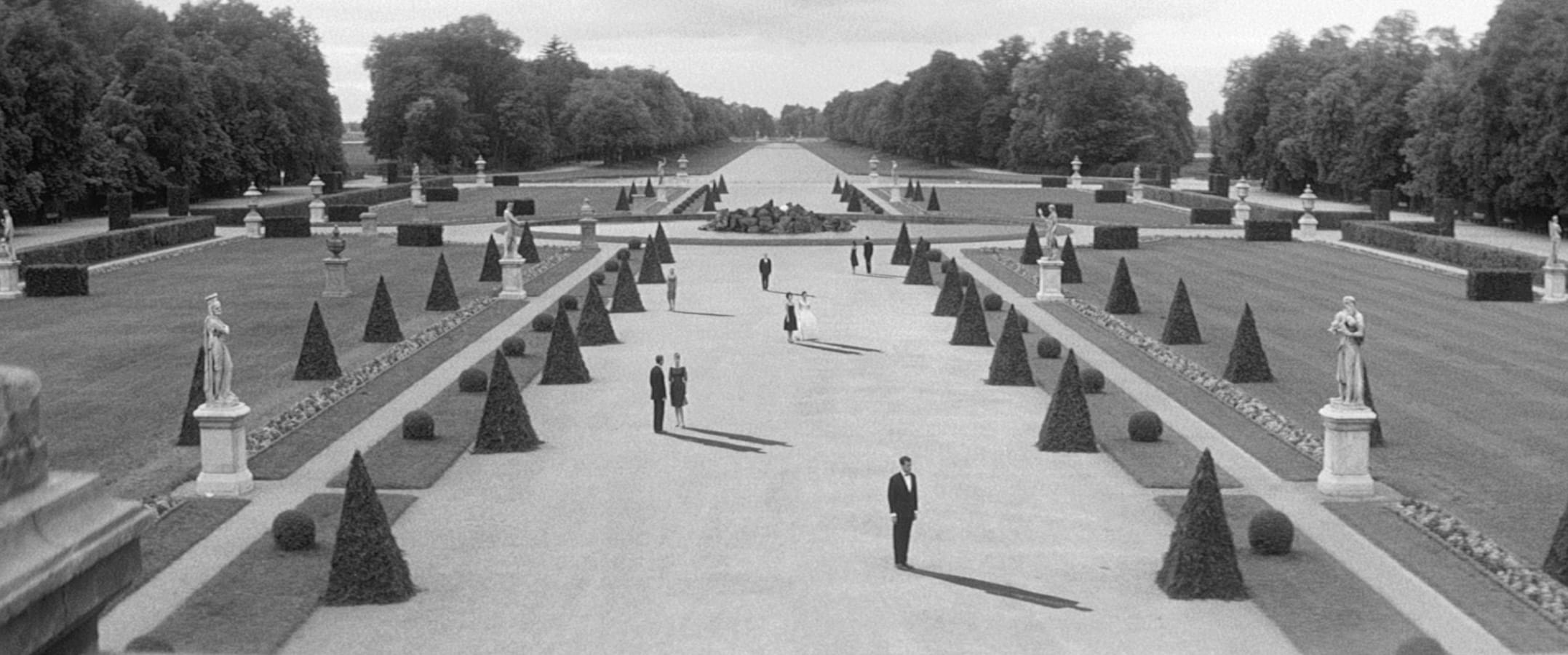
Last Year at Marienbad
Grade: B+
Famously (or infamously) impenetrable, Alain Resnais’ Last Year at Marienbad remains the pinnacle of European art film experimentation. If you love high surrealism, you’ll easily fall under the spell and will be delighted by the film’s unsolvable puzzles. If you don’t, then this is the easiest recommendation of “this movie is not for you” that I’ll ever make. A few more notes on Last Year at Marienbad:
Directing:
Through slow, claustrophobic tracking shots and repetitive, provocative visual (and audial) motifs, Resnais creates an inescapable (try as we might) work of surrealism. He induces the viewer into a trance as his camera snakes and probes through a dreamy luxury hotel populated with emotionless high-class residents, daring us to figure out what the fuck this film is all about. Then again, the point is not to decipher the meaning — Resnais would rather you submit to the opulent black-and-white imagery and simply follow where your subconscious takes you.
Last Year at Marienbad is an intentionally maddening movie, all about the experience. While it is rewarding, it isn’t quite as entertaining as the works of fellow surrealists like Luis Buñuel and David Lynch. Nevertheless, the director’s talent is undeniable — this is the ultimate cinematic modernist point of no return, inspiring countless imitators and pushing the French New Wave to its logical conclusion.
Acting:
There are three principal characters in Last Year at Marienbad, all unnamed. Giorgio Albertazzi stars as the man who believes he met a lover last year in a classical château. Maybe this château, or another one just like it. Delphine Seyrig stars as the beautiful woman who serves as the obscure object of his desire, who rejects his advances, or maybe doesn’t. And Sacha Pitoëff is the second man who may or may not be the woman’s husband, who resembles a vampire with his high cheekbones and deathly stare. The performers all do what Resnais asks them to do, which is wander dreamily and aimlessly, delivering ambiguous monologues devoid of feeling, graceful in their lifelessness. In this manner, their performances are exactly what the film calls for: a calculated expression of anti-acting.
Writing:
The screenplay by Alain Robbe-Grillet is elliptical. Dialogues are repeated, sometimes by different characters, and the film cleverly doubles back and forth in time and memory. The only element that remains constant is the palatial estate that the characters are confined to, which resembles a tomb more than anything. In terms of stream-of-consciousness, the film is terrific. However, in terms of pretentiousness, Last Year at Marienbad is too serious. It’s an experiment on the malleability of memory (I think), but the themes are entirely abstract rather than tangible, and the characters have no will of their own, which makes their aristocratic plight quite unrelatable. Lost Highway and The Shining (and Resnais’ own Hiroshima, Mon Amour) tackle the same ideas in a much more interesting fashion.
Music:
Last Year at Marienbad employs a free-wheeling organ soundtrack by Francis Seyrig (brother of lead actress Delphine). The all-encompassing sound is certainly hypnotic, but I personally find it to be too abrasive. It seems that Resnais and Robbe-Grillet want an overtly avant-garde score without considering how it fits with the film’s overall mood. Seyrig’s aleatoric organ music works best during the elongated opening sequence, in which all we see is the hotel’s architecture accompanied by Albertazzi’s cryptic narration. After that, the score calls too much attention to itself, distracting us from Marienbad’s many mysteries.
Ending (SPOILERS):
Ultimately, it doesn’t matter whether or not the man met the woman before, or whether the woman knows what really happened. I interpret the movie as a commentary on the artistic process — notice how different characters repeat the same dialogues during the start of the film, essentially standing in for the man and woman before the film literally finds its main characters, who subsequently attempt to retell their tale as they see fit. The man and woman change their stories, until one of them arrives at a suitable ending, the nature of which may or may not be true. It’s a story that invents itself as it goes along, which is genius, really. It’s a worthwhile spell to submit yourself to, even if the film’s central mystery lacks drama. A trip worth taking, but not a destination worth staying for long.
“Empty salons. Corridors. Salons. Doors. Doors. Salons. Empty chairs, deep armchairs, thick carpets.” — X
Why Last Year at Marienbad gets a B+:
The most intentionally confounding film ever made, Last Year at Marienbad is a fascinating unsolvable puzzle. As an intellectual exercise, the elliptical narrative is intriguingly mind-bending. But as a piece of entertainment, the film becomes tedious due to its lack of emotion.
Discover more from Colin's Review
Subscribe to get the latest posts sent to your email.
None of this is included in the film, but the book itself based on it about a 3D simulation, where the main character decides to stay within the matrix because he’s in love. The Invention of Morel, I think.
Thank you for commenting! I’m always interested in surreal works of art, so I’ll have to check out the book.
Looking back on it now, perhaps I’m a little too hard on “Marienbad” in the review – I used to think it was a masterpiece back when I watched it in college/high school – but my last few viewings have left me cold and wanting more (ironic, since that’s what director Alain Resnais wants you to feel). These days, I admire the film more than I like it, but I’m always glad to discuss it.