
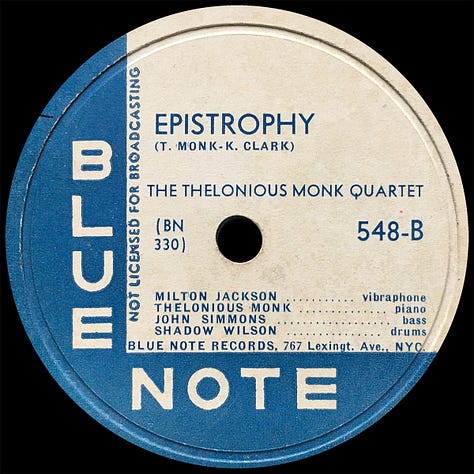
20. “Epistrophy” by Thelonious Monk
Led by a slightly sinister backbeat and eerie, off-kilter vibraphones, Thelonious Monk’s “Epistrophy” introduced atonalism to the world of jazz, while also introducing the world of jazz to Monk’s uniquely idiosyncratic style. They didn’t call him the “Genius of Modern Music” for nothing, and “Epistrophy” prophetically predicts the shape of jazz to come, seamlessly merging bebop and the avant-garde in a manner that is both playful and profound.
19. “Adieu mon cœur” by Édith Piaf
One of the most bittersweet songs ever recorded, “Adieu mon cœur” is Édith Piaf’s masterpiece. Her plaintive yet powerful vocal performance is an obvious highlight, carrying the mournful melody with dignified grace and lived-in melancholy. But what truly elevates the track is the tremendous arrangement, which combines dramatic classical orchestrations with uplifting swing instrumentation. The music provides the perfect companion for Piaf’s solemn soul-searching, all of which makes “Adieu mon cœur” a beautifully authentic tearjerker.
18. “I Can’t Be Satisfied” by Muddy Waters
Plugging in his electric guitar to a distorted amplifier, Muddy Waters helped bring the blues out of the Delta and into the downtown urban sprawl. His 1948 hit “I Can’t Be Satisfied” is louder and angrier than anything that came before: a simple yet affecting country blues, sung in a powerfully deep and soulfully expressive voice. Every individual note matters, and the straightforward no-nonsense technique adds wisdom to Waters’ words. Even though the subject matter is typical down-luck blues, you can feel the hardships in your very bones.
17. “Nature Boy” by Nat King Cole
If there’s one word to describe Nat King Cole’s “Nature Boy,” it’d be “timeless” — few songs can sound ancient and modern at the same time. Does “Nature Boy” hint at psychedelic self-discovery, or is it about mystic philosophy? Is there even a difference? Written by Californian proto-hippie eden ahbez [sic], the song’s lyrics are filled with evocative imagery and eternal wisdom. Another senior quote idea: “The greatest thing you ever learn/Is just to love and be loved in return.”
16. “Jeru” by Miles Davis
Miles Davis’ “Jeru” operates with a tremendous sense of synergy and reciprocation: all nine members of the jazz orchestra are in complete lockstep with one another. Written by baritone saxophonist Gerry Mulligan, the song features several woozy transitions that remain unresolved. It’s easy to get lost in the complex harmonies, but the song wouldn’t be anything without its great melodies and sense of rhythm — a stimulating workout for both brain and body.

15. “Parchman Farm Blues” by Bukka White
Mississippi State Penitentiary is one of the most infamous and notorious prisons in American history, noted for its harsh conditions and history of civil rights violations. It was in the jail — otherwise known as Parchman Farm — where blues musician Bukka White was recorded by music historian John Lomax. The hit songs that came about resulted in White becoming a minor celebrity, and he was released in 1940 after serving two years of his life sentence. He then wrote and recorded “Parchman Farm Blues,” which was curiously darker and more introspective than his pre-imprisonment music.
The disparate elements of the song come together perfectly: Delta-influenced slide guitar mixes with harsh, one-chord country; a simplistic acoustic beat is combined with a rhythmically complex accompaniment by Washboard Sam; and White’s guttural voice delivers a powerfully expressive melody.
14. “Catfish Blues” by Robert Petway
Similar to Rabbit Brown’s “James Alley Blues,” Robert Petway’s “Catfish Blues” is an obscure Delta blues classic that sounds unbelievably modern. Not much is known about the composer, and his other recordings are largely inessential, but there’s no denying that Petway struck gold with “Catfish Blues.” His raw, minimal style influenced the likes of John Lee Hooker, Muddy Waters and Jimi Hendrix, and his soulful vocals are among the most pleasurable to spring from the Mississippi Delta. All in all, a perfect match of sound and form.
13. “Where Did You Sleep Last Night?” by Lead Belly
As the final song on Nirvana’s MTV Unplugged in New York in 1994, “Where Did You Sleep Last Night?” has always possessed a haunting quality. Kurt Cobain channeled his “favorite performer” (i.e., Lead Belly) to create an eternal alt-rock touchstone, yet you could make the case that Lead Belly’s original 1944 recording of the song is even more impactful. The chord progression foreshadows grunge by 50 years, and Lead Belly’s ghostly vocal and ominous interjections turn this ambiguous murder ballad into something even more sinister.
12. “Honky Tonkin’” by Hank Williams
The chorus of Hank Williams’ classic “Honky Tonkin’” features odd time signatures, stop-time melodies and an unnatural chord progression. It shouldn’t work, but somehow, someway, Williams effortlessly makes these jagged edges fit. Paired with a stirring vocal, the unconventional chorus adds an air of tragedy to an otherwise jubilant country song, twisting the virtuoso instrumental performances (great solos by Tommy Jackson on fiddle, Smokey Lohman on steel guitar and Zeke Turner on electric guitar) into a fantastic portrayal of grand loserdom.
11. “I’m So Lonesome I Could Cry” by Hank Williams
“I’m So Lonesome I Could Cry” is the most poetic country song ever made, filled with evocative imagery that conjures solitude at its most destitute: a lonesome whippoorwill, a midnight train running low, the silence of a falling star, a robin weeping when leaves begin to die. Hank Williams delivers his most tender vocal performance, while Jerry Byrd’s weeping steel guitar and Tommy Jackson’s grieving fiddle gently lope beside him. Because the song is so plain and direct, the depressive sentiments are deeply felt without ever becoming overbearing. As Bob Dylan said: “I didn’t have to experience anything that Hank did to know what he was singing about. I’d never heard a robin weep, but could imagine it, and it made me sad.”
Jump to a Section