
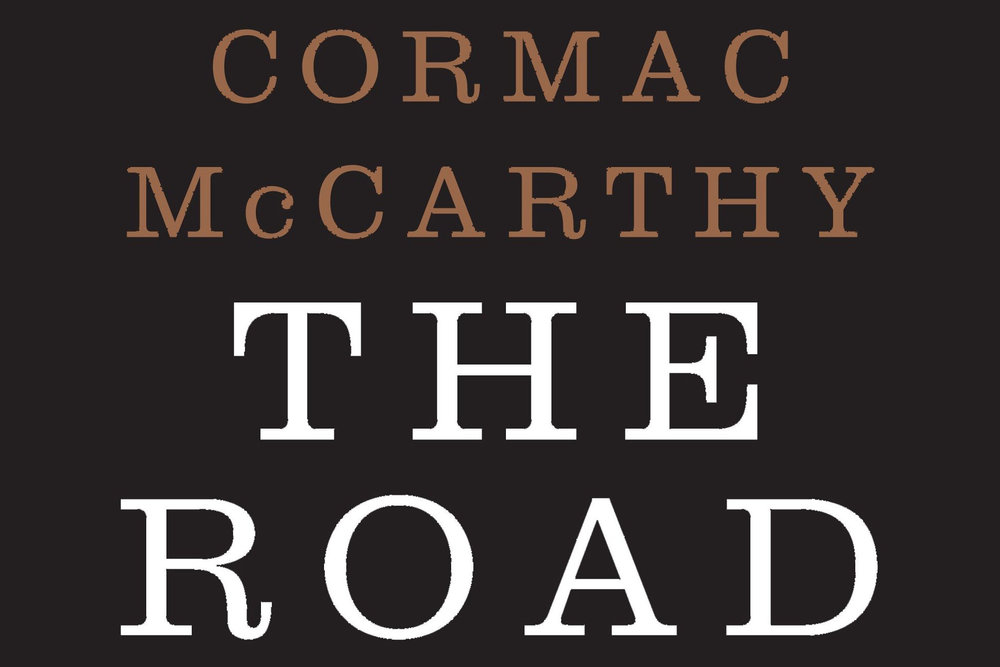
The Road
Grade: A
Spare and dark and impossibly heartbreaking, The Road is one of writer Cormac McCarthy’s greatest novels. A simple story: an unnamed father and son traverse a barren post-apocalyptic wasteland of what we can only assume to be America not long after an unbeknownst cataclysm has rendered the world for the most part uninhabitable. The pair hopelessly travel south along the remnants of the interstate highway, every day a brutal struggle to survive. Relatively straightforward, yet relentlessly bleak.
It’s a testament to McCarthy’s incredible talents that The Road is filled with some of the most beautiful and poetic writing of the 21st century. Despite the narrative being a neverending trudge of death and despair, the minimalistic prose makes every single sentence into a standalone, epic, emotional journey. I wouldn’t necessarily call the book hopeful — McCarthy makes clear that the father and son are pretty much doomed from the start — but the tale is a brilliant story of human perseverance. The Road is McCarthy at his most optimistic, which isn’t to say that the book lacks violence.
In fact, there is violence in every paragraph, on every page. For the most part, however, the 73-year-old McCarthy subverts his usual tropes and we never actually see any bloodshed firsthand. Only the gory aftermath. Whereas earlier McCarthy classics, like Child of God and Blood Meridian, mesmerized us with their unblinking looks at unthinkable atrocities, The Road prefers to horrify us with possibilities that are only hinted at.
The end-of-world cataclysm, for one, is never explained: Was it the result of nuclear war? Some irreversible ecological disaster? The lack of answers makes the situation even more despondent. Likewise, the gangs of cannibalistic marauders who roam the barren countryside are, luckily, only seen from a distance. Nevertheless, their barbarism is frighteningly easy to imagine. We’re forced to fill in the blanks for ourselves.
McCarthy’s prose, too, which is usually so dense and archaic, is stripped to its bare essentials (a process which started with The Crossing in 1994). By default, this makes The Road one of his most accessible novels, even if the depressive subject matter is anything but. McCarthy crafts a consistent tone that draws power from its precise, Old Testament-style repetition, which is perfectly befitting of the setting. Structured in a series of short paragraphs that provide quick bursts of poeticism, the godlessness of the landscape becomes palpable — the only way to tell such a painful story.

Still, The Road isn’t just torture porn and endless misery. The reason it remains so compelling is McCarthy’s ability to find beauty in the most unlikely places: the forgotten sweetness of an apple; a hidden cache of Coca-Cola; the momentary wonderment of a waterfall; the taken-for-granted salvation of surviving another day in a fading world where everything is either dead or dying.
And then there is the Boy, whose matter-of-fact innocence is the heart and soul of this book. The relationship between father and son — with dialogues based on real-life conversations McCarthy had with his own young child — is both inspirational and extra tragic and perhaps the purest character dynamic in any of his works.
In terms of similar philosophical territory, The Road reminds me a lot of director Alfonso Cuarón’s masterful 2006 film, Children of Men (released the same year as The Road). In both dystopias, which actually don’t seem too far off or all that implausible, humanity is surely dying and no one would be faulted for giving up. In fact, you could say there’s maybe even a moral obligation. But maybe, too, there is something still worth saving. Finding out the fate of The Boy is why The Road is worth reading.
And re-reading: like all McCarthy novels, The Road is even more rewarding the second or third time around. The narrative remains dreary beyond belief, but the tearful catharsis by the end of the story — tears of sadness, tears of joy — is enough to somewhat restore our faith in humanity. It’s also worth mentioning that the book’s final paragraph (“Once there were brook trout…”) is the best thing that McCarthy has ever written. Seriously: it’s one of the greatest concluding stanzas in all of literature.
All being said, The Road is a very strong book. Maybe not as strong and all-encompassing as, say, the aforementioned Blood Meridian, but then again few books are. The fact that McCarthy was still writing classics at this point in his career proves how great and singular an artist he truly was.
FURTHER READING:
- By my estimate, it’ll only be a matter of time before The Road is considered a modern classic. Here are a few great articles/reviews/analyses that explore the novel in further depth (the James Wood essay in The New Republic is particularly insightful):
STRAY OBSERVATIONS (including SPOILERS):
- Unlike many other dystopian stories, The Road is not a spiritual allegory or a social commentary or a scathing critique of the present day. It is sci-fi in name only, and it’s main thesis is simple: What would happen in the aftermath of an inescapable extinction event? How would the survivors…well…survive? It’s a very realistic novel in this regard, and much of The Road reads as a doomsday primer, detailing the Man’s incredible resourcefulness: searching for food, hunting for supplies, making camp, starting fires, hiding from potential threats, keeping the Boy safe, etc. Due to the powerful writing, such banal activities become profound, and like many of McCarthy’s über-masculine main characters, the Man is very intelligent when it comes to living off the land. Or what’s left of it, in this case.
- My guess for the cause of the cataclysm would be an asteroid impact or a very large volcanic eruption, both of which would block out the sun with ash and cause the death of most plant and animal life. The reason why I wouldn’t assume nuclear war is because of the seeming lack of radiation. Not that it matters anyway — The Road isn’t intended as a mystery.
- Or it could just be that God decided that it was time for humanity’s day of reckoning. The prose is biblical, as usual with McCarthy, and the Man curses out God several times throughout the novel. However, the way McCarthy describes the post-apocalyptic landscape seems to suggest an indifferent universe.
- I do have a slight problem with the way religion is handled in The Road, especially in the final pages. Obviously, I’ve described McCarthy’s writing — the polysyndentons, the apocalyptic vocabulary, the stark battle between good and evil — as biblical in nature. And, of course, the Man makes several references to God’s absence. Such things cannot be avoided in a post-apocalyptic novel. Nevertheless, the final pages seem to suggest a turn to Christianity, whereas the entire book had so carefully built up a worldview where theology is deemed inconsequential. This change is quite abrupt, and a tad too sentimental, even if it is endearing and hopeful.
- “The clocks stopped at 1:17. A long shear of light and then a series of low concussions.” This is as close we get to an explanation of what happened. A meteor, perhaps?
- Strange to say, but the most compelling aspects of The Road are the terrifying blood cults and the fear they inspire: the demonic chanting and screams in the night; the savage appearances of small hordes leading their chained pregnant slaves down the road; the horrifying discovery in the trapdoor of the farmhouse, where prisoners are tortured and barely kept alive as a source of food. Deathly chilling because of how probable these things would be. In some spots, The Road is a horror novel.
- The Road doesn’t have the strong characterization of other McCarthy books, but that’s because in the Hierarchy of Needs, survival takes precedence over all else. Unfortunately, the book can occasionally become a bit one-note and humorless as a result. However, there is some fantastic character development toward the end, when the Boy grows up before our very eyes. His dialogue becomes more mature, and he becomes the one who looks out for his dying father. It’s cleverly subtle and extremely sad.
- I’m glad that the Boy does meet another family after his father dies, providing us with some semblance of hope at the end. Not necessarily a “happy” ending, but there exists the small fraction of a possibility that humanity could survive.
- Then again, that final paragraph — as beautiful and poetic as it is — seems to be a signifier that things “could not be put right” again. The patterns on the brook trout will never be seen again. They will forever hum of mystery, only to exist in a fading memory of the world now gone. Subscribing to this theory, the Boy and his new family are just as doomed as everyone else, undercutting any sense of optimism.
- The 2009 movie adaptation of The Road (directed by John Hillcoat) follows the story very closely, and Viggo Mortensen gives a great performance as the Man, but the movie is certainly not as powerful as the book. McCarthy’s lyrical passages are impossible to translate to film. Unless you’re the Coen brothers, that is.
QUOTES FROM THE ROAD:
- Then they set out along the blacktop in the gunmetal light, shuffling through the ash, each the other’s world entire.
- Neither of them had spoken a word. This was the perfect day of his childhood. This the day to shape the days upon.
- The man thought he seemed some sad and solitary changeling child announcing the arrival of a traveling spectacle in shire and village who does not know that behind the players have all been carried off by wolves.
- Because we’re carrying the fire.
- Borrowed time and borrowed world and borrowed eyes with which to sorrow it.
- And perhaps beyond those shrouded swells another man did walk with another child on the dead gray sands. Slept but a sea apart on another beach among the bitter ashes of the world or stood in their rags lost to the same indifferent sun.
- When he went back to the fire he knelt and smoothed her hair as she slept and he said if he were God he would have made the world just so and no different.
- They went on in the perfect blackness, sightless as the blind.
- Perhaps in the world’s destruction it would be possible to see at last how it was made.
- Final Lines: Once there were book trout in the streams in the mountains. You could see them standing in the amber current where the white edges of their fins wimpled softly in the flow. They smelled of moss in your hand. Polished and muscular and torsional. On their backs were vermiculate patterns that were maps of the world in its becoming. Maps and mazes. Of a thing which could not be put back. Not be made right again. In the deep glens where they lived all things were older than man and they hummed of mystery.
Discover more from Colin's Review
Subscribe to get the latest posts sent to your email.