
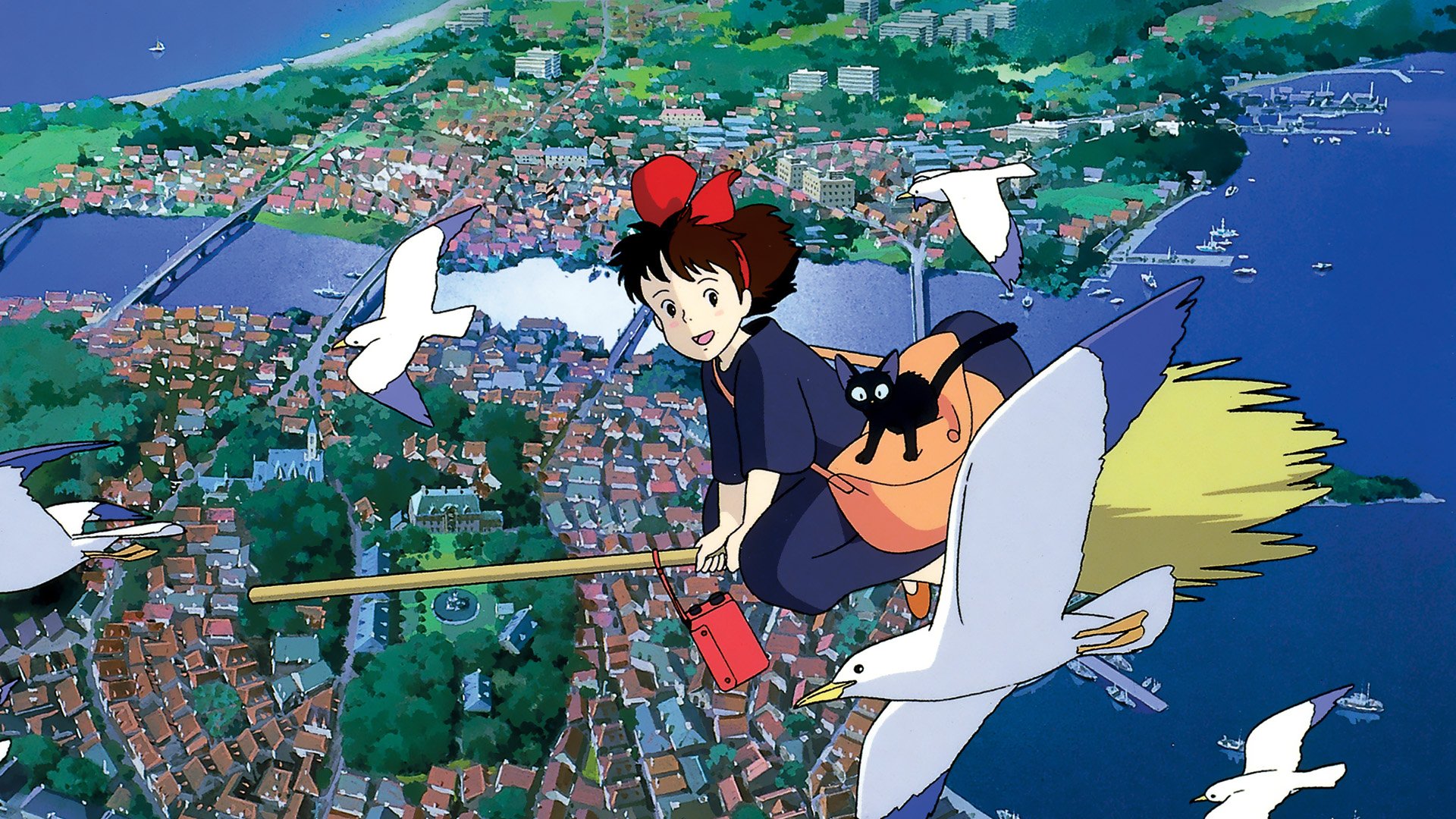
Kiki’s Delivery Service
Grade: A
Japanese master animator Hayao Miyazaki rose to international prominence in the early 2000s with the release of Spirited Away, but he was making classic films long before that. Kiki’s Delivery Service, originally released in 1989, is one of his simplest and most affecting fables; a film far ahead of its time in its direct (and uplifting) depiction of depression. A few more notes on Kiki’s Delivery Service (DISCLAIMER – I’m reviewing the original Japanese audio version of the film):
Directing:
As always with Miyazaki, every frame of Kiki’s Delivery Service is a painterly sight to behold — some of the most beautiful animation you’re ever likely to see. Yet unlike many of his other fantasy films, Kiki’s takes places in a modern day setting, amidst a hustling and bustling coastal city. The wondrous thing about this film is how Miyazaki so casually inserts elements of magic into ordinary life. He seamlessly integrates the world of fantasy and reality that such taken-for-granted everyday occurrences like friendship, painting and blimps are just as extraordinary as witches, flying broomsticks and talking cats. Through the film’s subtly evocative imagery, the joys and pains of life itself are easily felt.
Acting:
The best way for a viewer to capture the magic and childlike sense of wonder in Kiki’s Delivery Service is to watch the original Japanese audio version. As good as Kirsten Dunst and Phil Hartman are — and as impressive as the Disney dub is — the original is obviously the most authentic. Minami Takayama perfectly conveys Kiki’s vulnerability and heart-on-the-sleeve emotion, while Rei Sakuma transforms Jiji into a wiser and funnier and more endearing feline sidekick. In both cases, humor and heart are amplified.
Writing:
Based on the 1985 Japanese children’s fantasy novel of the same name, Kiki’s Delivery Service is Miyazaki’s simplest tale. Sure, our main character is a teenage witch figuring out magic for herself, but within the world of the film, such things are not out of the ordinary. The tone is so innocent and optimistic that the plot readily becomes commonplace, and — together with the lush animation — we’re instantly immersed and invested in the story. There is no big quest, no villains or violence; this is a fantasy film relying on small stakes, such as making new friends and overcoming depression and self-doubt. Like My Neighbor Totoro before it, the beauty of Kiki’s Delivery Service lies in its immense relatability.
Music:
Frequent Miyazaki collaborator Joe Hisaishi delivers another memorable, melodic soundtrack that becomes inseparable from the imagery. For Kiki’s Delivery Service, his music is a cross between classical, jazz and lovably dated 1980s pop. But, for me at least, the best music is played over the end credits: an incredible folk-rock tune called “Embraced in Softness” by Yumi Arai (from her 1974 album Misslim). Filled with lush pedal steel and soaring melodies, it’s a terrific song that serves as a tremendous capstone to the film.
Ending (SPOILERS):
Kiki’s Delivery Service ends quite suddenly, immediately after the climactic resolution, without any falling action whatsoever. In fact, it’s surprising how fast the film concludes: after rescuing her friend, Tombo, from a blimp accident, Kiki has finally and triumphantly regained her confidence, and that’s that. Despite the swift cut to the end credits, it’s a suitable happy ending without any saccharine embellishments.
The slightness of the ending is endearing, and the song by Yumi Arai makes it even better. It might not be quite as profound or thought-provoking as the finales to Princess Mononoke or Spirited Away, but it’s an excellent way to end such a simple film. And if you’re the type of person that needs a little more closure, there’s a brief epilogue in which Kiki writes a letter to her parents back home. Life goes on, and childhood lives forever. Has there ever been another movie so pure of heart as this one?
“If I lose my magic, that means I’ve lost absolutely everything.” — Kiki
Why Kiki’s Delivery Service gets an A:
A combination of lush animation, instantly lovable characters and the simplest of storylines makes Kiki’s Delivery Service one of Hayao Miyazaki’s greatest and most underrated gems. It isn’t as epic as Spirited Away or Princess Mononoke, but it doesn’t need to be. It’s perfect just the way it is.
Accolades:
Colin’s Review Best Films of the 1980s
Discover more from Colin's Review
Subscribe to get the latest posts sent to your email.