
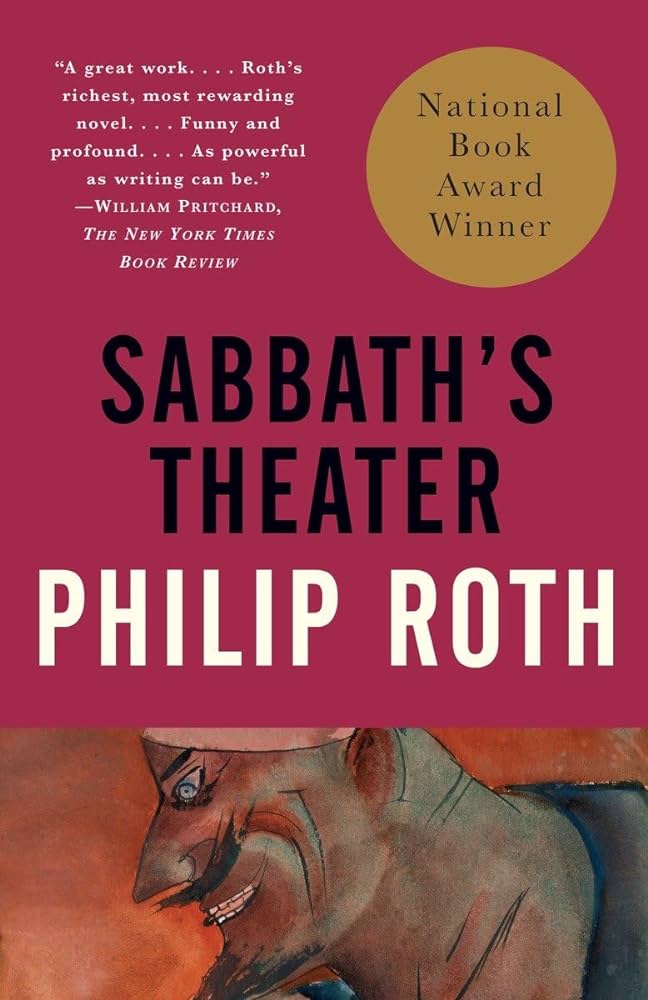
Sabbath’s Theater
Grade: A+
Sabbath’s Theater is many things: depraved, perverted, offensive, uncomfortable, fucked up, funny, insightful, profound, poignant, life-affirming. It’s a contradictory novel about the human condition, in all its detestable and delectable forms — “contradictory” because of the strange emotions it somehow elicits; “human condition” because its main character is such a lech. Then again, who else is a better example of living than Mickey Sabbath, the dirtiest of dirty old men? And who else is a better artist to bring his strange, twisted life — or what’s left of it — to vivid reality than Philip Roth, the prolific novelist who weaves fiction with autobiography like no other author in all of postmodern literature?
Somewhat similar in subject matter to Roth’s scandalous 1969 classic, Portnoy’s Complaint, the indecent Sabbath’s Theater follows the failed life of former puppeteer Mickey Sabbath — a self-described whoremonger, seducer, sodomist, abuser of women, destroyer of morals and ensnarer of youth — who is surrounded by, haunted by and delighted by death all around him. It’s only natural that the central conflict of the book is whether or not Sabbath possesses the gall to kill himself.
It’s a dark novel, obviously, but Roth’s humor and conversational tone shines through. We are repulsed by Sabbath but also strangely compelled by him, and some of the most entertaining passages of the book are when he is at his most debauched: coercing young waifs, reminiscing of old whorehouses and engaging in deviant sexual acts, which are described in comically repulsive detail. The protagonist is not unlike Vladimir Nabokov’s Humbert Humbert (of Lolita): a gargantuan antihero of epic perversions…er…proportions.
However, through playful, figurative prose and lengthy, well-constructed sentences and paragraphs, Roth obliges us to get inside Sabbath’s head. His problems become our problems, and we gleefully await his next scandal with rapt attention. It’s a book that never bores despite its unfriendly structure (very few chapter breaks) and somewhat lengthy page count (451 in the Vintage International Edition).

But Sabbath’s Theater is much more than a wicked comedy; gradually, it becomes a powerful and thought-provoking meditation on life and death. Much of the book is told — in typical Roth style — via flashback and digression into the past, and we slowly discover why Sabbath is the tortured and torturous man he is today. To get readers to sympathize with and maybe even root for such a debauched disgrace of a human being is one of Roth’s greatest accomplishments.
The deeper into the book you get, the more it envelops you. Roth creates a web of memories that ensnare Sabbath and the reader alike. As a result, Sabbath’s Theater becomes an unflinching, no-stones-unturned look at life itself — a failed life, but a life nonetheless.
It’s a book that isn’t necessarily for everyone: if you don’t like Roth, you certainly won’t like Sabbath’s Theater. On the contrary, though, this is perhaps the ultimate Roth novel; one that delights us with its casual obscenity and awes us with its surprisingly epic nature. The frequent literary allusions to William Shakespeare and William Butler Yeats are no coincidence: Sabbath’s Theater uncovers the human condition like few other novels of the 1990s. As much as it’ll make you laugh, it’ll also make you cry.
In particular, there is a 60-page stretch toward the end (pg. 351-412) — in which Sabbath buys his own grave, visits his 100-year-old Cousin Fish and sorts through his long-dead brother’s keepsakes — that is among the most resonant, powerful and saddest passages that Roth, or any modern author, has ever written. Like Hamlet contemplating the skull of Yorick, or Nathan Zuckerman being cursed out by his dying father, Sabbath’s Theater is an unwavering contemplation on the psychological mysteries that most of us fear to think about. For fans of self-referential postmodern fiction, Sabbath’s Theater is highly recommended. This is a great book.
FURTHER READING:
- Sabbath’s Theater is often hailed as one of Roth’s greatest works, and far better readers/reviewers than I have written extensively on its impact. Here are a few great articles/reviews/analyses that dive into Sabbath’s Theater in more detail:
- https://www.nytimes.com/1995/09/10/books/sabbaths-theater.html
- https://www.kirkusreviews.com/book-reviews/philip-roth/sabbaths-theater/
- https://www.reddit.com/r/books/comments/55rlc9/sabbaths_theater_by_philip_roth_is_a_masterpiece/
- https://themillions.com/2011/08/staff-picks-sabbaths-theater-by-philip-roth.html
STRAY OBSERVATIONS (including Spoilers):
- Roth has always been sex-obsessed in a manner similar to fellow Jewish artist Woody Allen. And, yes, part of the entertainment value in Sabbath’s Theater is reading the deplorable ways in which Mickey Sabbath continuously tops his most deviant acts. But in its comedy, Sabbath’s Theater is deathly serious: by revealing so openly Sabbath’s darkest sexual desires, Roth plumbs the painful truths that afflict us all. Rarely are novels so confessional, so candid, so honest.
- In his quest to kill himself, Sabbath tries to prove the meaninglessness of life. But with every attempt, he ultimately proves the opposite: that life is filled with meaning. He loves being his unpleasant self far too much to stop, and the final paragraph of the book brilliantly and bluntly sums up his sense of purpose: “He could not fucking die. How could he leave? How could he go? Everything he hated was here.”
- Sabbath’s Theater is divided into two parts (respectively titled “There’s Nothing That Keeps Its Promise” and “To Be or Not To Be”), with occasional untitled chapter breaks. Because Roth’s prose is so rapid-fire and methodical, and because there are so many shocking acts and funny jokes on each page, it is very easy to read the book in large, easily digestible chunks.
- The events of the book take place over the course of only a few days. However, through Roth’s trademark familial recollections, the entire portrait of Sabbath’s 64 years is painted clearly and vividly. In its narrative, Sabbath’s Theater operates on a semi-stream-of-consciousness postmodern scale, with Roth’s typical blurring of fiction with reality touching on themes of identity, family dynamics, psychosexual makeup and the hysteria of postwar American life.
- My favorite passages of Sabbath’s Theater are the ones in which Sabbath remembers his older brother, Morty, who died in World War II at the age of 18. All the loss in Sabbath’s life can be traced back to this moment, and all the immorality of his being can almost be forgiven due to these tragic, sorrowful, compassionate recollections.
- The end of the book is memorable, if not a tad overshadowed by the aforementioned poignant 60-page stretch that leads up to it. Either way, Sabbath’s already-destroyed life is deliberately destroyed even further, but still he clings to it. It’s a win for humanity: an optimistic ending despite its utter bleakness.
- The great literary critics Harold Bloom and James Wood, who rarely agree, both posit that Sabbath’s Theater is Roth’s greatest novel. I’m more partial to American Pastoral myself, but I’m glad that this book has been widely acclaimed for its vitality.
- Sabbath is a fan of Benny Goodman and frequently references the 1938 Carnegie Hall Performance (which is the Colin’s Review Greatest Album of the 1930s) and the performances of his big band.
QUOTES FROM SABBATH’S THEATER:
- He went in at eighteen and he was dead at twenty. Shot down over the Philippines December 12, 1944.
- And afterward, each of these sated fellows said to her exactly the same thing: the ponytailed electrician with whom she took baths in his apartment, the uptight psychiatrist whom she saw alternate Thursdays in a motel across the state line, the young musician who played jazz piano one summer at the inn, the nameless middle-aged stranger with the JFK smile whom she met in the elevator of the Ritz-Carlton…each one of them said, once had recovered his breath—and Sabbath heard them saying it, craved their saying it, exulted in their saying it, knew it himself to be one of the few wonderfully indisputable, unequivocal truths a man could live by—each one conceded to Drenka, “There’s no one like you.”
- Ascetic Mickey Sabbath, at it still into his sixties. The Monk of Fucking. The Evangelist of Fornication. Ad majorem Dei gloriam.
- Something horrible is happening to Sabbath.
- Puppets. Of all the fucking callings. Between puppets and whores, he chooses puppets. For that alone he deserves to die.
- Mishima. Rothko. Hemingway. Berryman. Koestler. Pavese. Kosinski. Arshile Gorky. Primo Levi. Hart Crane. Walter Benjamin. Peerless bunch. Nothing dishonorable signing on there. Faulkner as good as killed himself with booze.
- So little in life is knowable, Reader—don’t be hard on Sabbath if he gets it wrong.
- I’d ask Morty—when he was first teaching me off the jetties with a small rod and reel, one made for fresh water—“Where do the fish go to?” “Nobody knows,” he said. “Nobody knows where the fish go. Once they go out to sea, who knows where they go to? What do you think, people follow them around? That’s the mystery of fishing. Nobody knows where they are.”
- Final Lines: And he couldn’t do it. He could not fucking die. How could he leave? How could he go? Everything he hated was here.
Discover more from Colin's Review
Subscribe to get the latest posts sent to your email.