
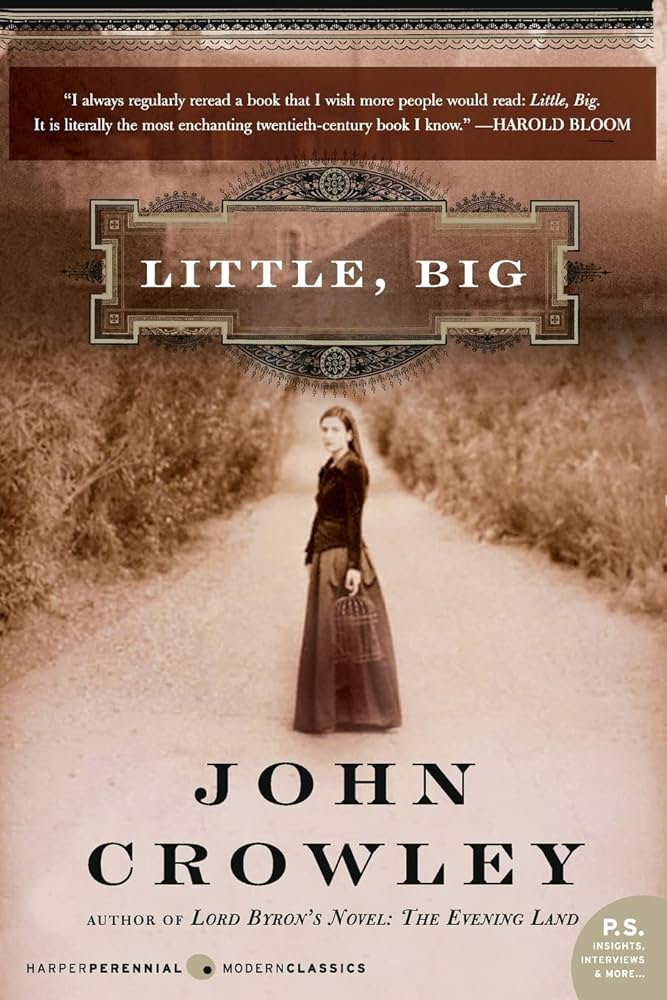
Little, Big Review
Grade: A+
As soon as I finished reading Little, Big for the first time, I immediately began reading it again, and I anticipate I will continue to do so for as long as I live, because John Crowley’s 1981 American fantasy masterpiece is a novel that only gets better and better the more you revisit it. Fitting that the final stanza includes the phrase “once upon a time,” immediately beckoning us back to the beginning.
The more you study the novel’s minutiae the ever-more infinite it becomes. It’s a book about many things; everything, in fact, but also a book about one thing: the telling of a Tale, the greatest Tale; life itself, in all its endless possibilities and permutations.
For such a vast all-encompassing scope, Little, Big is a simple story about four generations of a peculiar American family who live in an even more peculiar house called Edgewood. The family (the many descendants and relatives of patriarch John Drinkwater) is aware of and protected by fairies and spirits from another dimension, yet the family’s exact relationship with this other world is quite uncertain even to them. The Drinkwaters are constantly aware of the fairies’ presence, yet the fairies themselves are seldom seen, only appearing occasionally and always for reasons unknown. All anyone knows is that a Tale is being told, and the Drinkwaters’ role in it, whatever that might be, is of immeasurable importance.
All throughout the novel, Crowley’s prose is beautiful in both its complexity and its straightforwardness. He writes in a semi-stream-of-consciousness style that rivals the raw emotional intricacy of William Faulkner but does so in a calm and coherent manner that echoes the realism of Ernest Hemingway. Every single sentence is a prose poem of elegant construction, and it’s certainly no exaggeration to compare Crowley’s talents with these well-respected 20th century literary icons. And it’s certainly not a stretch to rank Little, Big alongside or even above As I Lay Dying or A Farewell to Arms or any other great American novel. The book is a literary masterpiece that subverts and transcends the fantasy genre (even though fans of traditional fantasy literature may take a little while to warm up to it).

Personally, I was hooked by Little, Big right away (by page five, in fact, when main characters Smoky Barnable and Daily Alice Drinkwater fall in love, which Crowley describes in such a sincere and empathetic manner). After that, I was enchanted by the book’s structure: every chapter is a standalone work of art, bouncing both forward and backward in time, with a multifaceted and multilayered sense of poetic discovery. Crowley integrates all the novel’s themes seamlessly, making no distinction between magic and reality and treating both with a matter-of-factness that disorients and delights. He withholds information to tease us but gives us just enough to hunger for more, creating a novel that deserves to be studied closely.
It’s these contradictions that make the book so alluring, so special — a secret that is just out of reach, or a mystery left unresolved. Fantasy and philosophy, myth and memory, skeptics and believers, love and war, life and death; all interwoven in a masterful structure that teaches us to appreciate the world around us and our place in it, no matter how clear or cryptic it becomes.
More than anything, though, Little, Big is a great love story; love of the world around us; one that is filled with immense power and wisdom. The characters are all well-written and interconnected, and it’s the rare book where everyone is not only relatable but also likable: there are no villains; just true-to-life depictions of family dynamics in all their eccentricities. All the while, the fairies exist on the fringes, adding an existential sense of dread and a metaphysical sense of wonder to every event, whether mundane or fantastic.
In fact, on second and third readings, the fairies seem to exist at every turning, in every paragraph, in every sentence, every word calculated and carefully composed. One of the great joys of revisiting Little, Big, and the main reason for its endless appeal, is the possibility that all Crowley’s details are evidence that magic exists. The other world is all around us, but it is so small that we hardly notice it at first glance.
Then again, Crowley’s prose also asks us to consider that the fairies don’t exist at all: the Tale might just be a dream, or a drug, or a memory, or make-believe, or death, or nature, or love, or storytelling itself. There might not be any magic around us at all, depending on how you look at it.
Overall, Little, Big is a monumental achievement — sad and happy; uplifting and despairing; bewildering and bewondering; epic and simple. Altogether, it’s one of my favorite novels, and it is always a great joy to revisit. Flip to a random passage and the rich memories will come flooding back, like a house unlocked, always alight and waiting to welcome us. And I’ll be happy to re-read Little, Big for as long as my part in the Tale goes on, for the things that make us happy make us wise.
FURTHER READING:
- Despite being Crowley’s most acclaimed work and garnering tremendous praise throughout the literary community, I still feel that Little, Big is underrated and relatively unknown outside of niche circles. It’s a book that is so well-written and full of meaning that I’m surprised there hasn’t been many, or any, studies on it. Here are a few great articles/reviews/analyses that give Little, Big its due:
STRAY OBSERVATIONS (including SPOILERS):
- The only aspects of the novel that are somewhat tedious, or confusing, are the storylines involving the characters of Ariel Hawksquill and Russell Eigenblick. They seem disconnected from the rest of the characters, and Crowley’s prose and literary allusions become quite heavy and almost impenetrable during these passages. But on subsequent re-reads, I’ve found that these sections are a lot more interesting, and funnier, than they initially seemed. In fact, the Hawksquill P.O.V. sections unlock the entire scope of the novel and provide the reader with the key to understanding the story’s internal mythology. Crowley deliberately obscures the meaning in these passages because of how important they are to revealing the meaning of life in Little, Big, which isn’t meant to be known anyway.
- There is a lot to unpack within every sentence in Little, Big, involving numerology, mythology, metaphysics, philosophy and the nature of storytelling itself. There are references to Lewis Carroll and Shakespeare and classical folklore. It’s implied that stories themselves are alive, and the Tale is the story of everything, even you and me.
- Smoky Barnable, our de facto main character, seems to subconsciously realize that his life is just a part in someone else’s story. His introduction in the first pages is his creation, in a sense, made to fulfill the Drinkwaters’ purpose, and his name (Smoky, his nickname, and Evan S., his real name, evanesce, used only once) is a reflection of his anonymity. He doesn’t come into form until he is part of the Tale, written down by Crowley in Little, Big.
- The novel is divided into five books, each one serving as a standalone yet interconnected part of a larger whole. In order from best to least-best, I’d rank them as follows: 1) “Book One: Edgewood” 2) “Book Three: Old Law Farm” 3) “Book Six: The Fairies’ Parliament” 4) “Book Two: Brother North-Wind’s Secret” 5) “Book Four: The Wild Wood” and 6) “Book Five: The Art of Memory”
- Personally, I found the book easiest to digest one chapter at a time. Because of the complex prose and hidden meanings that invite slower, more deliberate reading — and the fact that each chapter is at least 20 pages — Little, Big is best taken in small bits. Sit down for 40 minutes, read a chapter and reflect on the poignancy it leaves you with. Then repeat.
- The final chapters of the book are fantastic. Little, Big has a superb and powerful ending, that much cannot be denied. Even so, I find myself unable to grasp certain aspects, as the book offers no easy explanation and becomes quite allegorical as it draws to a close.
- What I gather from the end is that the Tale, whatever that means, is different for everyone. It’s a lot like religion and faith, in a way. Did the characters die? Have they always been dead? Were the fairies real? Were the characters the fairies the whole time? Either way, the final section (sub-titled “Once Upon a Time”), which chronicles an empty Edgewood decaying over the years, is one of my favorite passages in all of modern literature, echoing the end of Gabriel Gárcia Márquez’s 100 Years of Solitude.
- In a literal interpretation, it seems that the Drinkwater family was descended from fairies. The mythological inner world of Faerie is dying, and so a new one must be created further inward, which seems to involve absorbing our world, the infundibular outermost layer. The fascist dictator, Russell Eigenblick, himself a reincarnation of Holy Roman Emperor Frederick Barbarossa, is installed as a distraction, a storm that creates the coming spring. At the end, everyone who believes in Faerie enters a new existence: Daily Alice seems to become Mother Earth; Auberon and Sylvie become Oberon and Titania; Smoky Barnable is dead because he never believed. The Tale will be retold over and over again, just as it always has.
- There are several passages that I would describe as sublime: the description of Grandfather Trout (sub-titled “Suppose One Were a Fish”) is like Faulkner at his best; the passage where Smoky, Alice and Sophie gaze at the constellations (sub-titled “Little, Big”) is the keynote passage of the entire book; and the sequence where young Auberon loses his imaginary friend, Lilac, is tremendously thrilling and tragic (chapter three of “Old Law Farm).
QUOTES FROM LITTLE, BIG:
- He stopped at a bench where people could catch buses from Somewhere to Elsewhere.
- In a moment of silence they simply looked at each other, and understanding hummed, thundered within Smoky as he realized what had happened: not only had he fallen in love with her, and at first sight, but she at first sight had fallen in love with him, and the two circumstances had this effect: his anonymity was cured.
- “The things that make us happy,” he said, “make us wise.” And she smiled, and nodded, as who should say: yes, those old truths are really true.
- John had asked her: Do fairies really exist? And there wasn’t any answer to that. So he tried harder, and the question got more circumstantial and tentative, and at the same time more precise and exact; and still there were no answers, only the fuller and fuller form of the question, evolving as Auberon had described to her all life evolving, reaching out limbs and inventing organs, reticulating joints, doing and being in more and more complex yet more and more compact and individuated ways, until the question, perfectly asked, understood its own answerlessness. And then there was an end to that. The last edition, and John died still waiting for his answer.
- The tears of those who never cry, the calm, the levelheaded ones, are terrible to see.
- Daily Alice couldn’t tell if she felt huge or small. She wondered whether her head were so big as to be able to contain all this starry universe, or whether the universe were so little that it would fit within the compass of her human head.
- There was no entrance but a tiny hole at the window corner where the solstice-midnight wind blew in, piling dust on the sill in a little furrow: but that was room enough for them, and they entered there.
- His natural timidity overcome by a rush of family feeling, the Meadow Mouse put his nose out of the niche in the wall and attempted a greeting: ‘My great-great-grandfather knew the Doctor, he called out. But the fellow went right on. The Doctor could talk with the animals, but the boy, apparently, could not.
- When at last he slept for real, though, it was of nothing in Old Law Farm that he dreamt, but of his earliest childhood, of Edgewood and of Lilac.
- “Don’t go. Please, Lilac. Don’t go, you’re the only secret I ever had!”
- Alice’s white hand blotted out the grieving moon like clouds, and the sky grew blue.
- Come from his burial, none knew where but she, Daily Alice came among them like daybreak, her tears like day-odorous dew.
- Then Alice walked alone there, by where the moist ground was marked with the dark circle of their dance, her skirts trailing damp in the sparkling grasses. She thought that if she could she might take away this summer day, this one day, for him; but he wouldn’t have liked her to do that and she could not do it anyway. So instead she would make it, which she could do, this her anniversary day, a day of such perfect brilliance, a morning so new, an afternoon so endless, that the whole world would remember it ever after.
- Final Lines: One by one the bulbs burned out, like long lives come to their expected ends. Then there was a dark house made once of time, made now of weather, and harder to find; impossible to find and not even as easy to dream of as when it was alight. Stories last longer: but only by becoming only stories. It was anyway all a long time ago; the world, we know now, is as it is and not different; if there was ever a time when there were passages, doors, the borders open and many crossing, that time is not now. The world is older than it was. Even the weather isn’t as we remember it clearly once being; never lately does there come a summer day such as we remember, never clouds as white as that, never grass as odorous or shade as deep and full of promise as we remember they can be, as once upon a time they were.
Discover more from Colin's Review
Subscribe to get the latest posts sent to your email.