
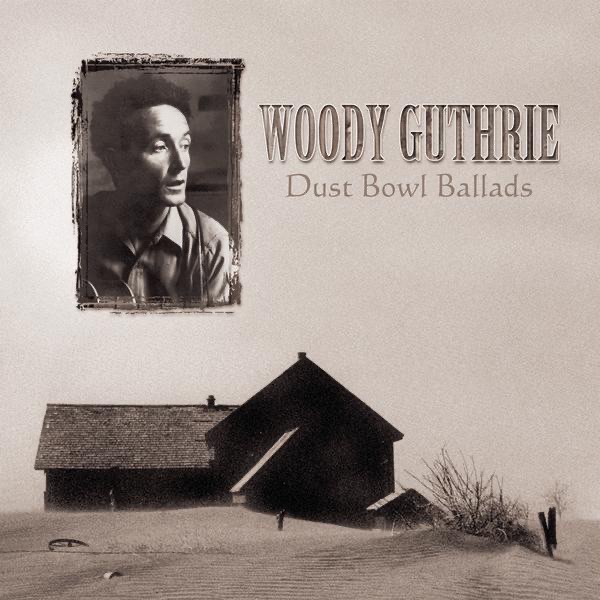
Album: Dust Bowl Ballads
Artist: Woody Guthrie
Year: 1940
Genre: Folk
Grade: A
Oklahoma-born, California-bound troubadour Woody Guthrie was the most famous and prolific of all American folk singers. Armed with only a harmonica and an acoustic guitar inscribed with the words “THIS MACHINE KILLS FASCISTS,” Guthrie became the voice of the working-class throughout the 1940s, traveling across the country to impart messages of protest and activism. His 1940 album, Dust Bowl Ballads, remains one of the most stark and authentic accounts of American life recorded in the 20th century.
It’s a fantastic album that still resonates today, even if it is quite simplistic in musicality. But that simplicity is part of the charm — Guthrie’s flat voice and straightforward chord progressions turns the listener’s attention toward the lyrics, which are descriptive and humorous and candid and eye-opening. All other American music prior to Dust Bowl Ballads can be classified as escapism, whereas these 12 tunes are as realistic as a Dorothea Lange photograph or a John Steinbeck novel. This is the where the singer/songwriter was born.
Even though Dust Bowl Ballads is quite bleak (the album has become synonymous with the Great Depression), it’s still a very pleasurable listen. Guthrie may have been a political activist, but he was an entertainer first and foremost, and despite the overall serious nature of this album, he was responsible for hundreds of songs of all varieties throughout his career — a folk singer who will sing about practically anything.
All his various personas are collected on Dust Bowl Ballads. For instance, the novelistic story-songs “Pretty Boy Floyd” and “Tom Joad (Parts 1 & 2)” paint a vivid picture of outlaws and Okies seeking a reason for being. In Guthrie’s typical deadpan irony, death seems to be the only way out, which is something that we can all laugh at. Meanwhile, songs like “Talkin’ Dust Bowl Blues” and “I Ain’t Got No Home in This World Anymore” look on the bright side of life, with poetic jokes and metaphors that scathingly stab at modern society. On the other side of the coin are desolate dirges like “The Great Dust Storm” and “Dust Pneumonia Blues,” which pull no punches in their matter-of-fact tales of tragedy.
The more you listen, the better Dust Bowl Ballads gets. Guthrie’s repetitive vocal melodies become infectious, and his guitar accompaniment is filled with rhythmic subtleties that propel the narratives. Even over 80 years after its release, Dust Bowl Ballads still perfectly embodies the blue-collar spirit, having inspired everyone from Bob Dylan to Bruce Springsteen to Billy Bragg. It’s one of the most important folk albums ever made.
Discover more from Colin's Review
Subscribe to get the latest posts sent to your email.